
 MileIntel
I Built a Devaluation Alert System. It Wasn't Ready for Aeroplan.
I thought our alert pipeline was solid. Then Aeroplan restructured its entire award chart in under 2 weeks and exposed every gap I'd ignored.

I Built a Devaluation Alert System. It Wasn't Ready for Aeroplan.
On May 20th, Air Canada Aeroplan quietly expanded its award pricing from 3 tiers to 5. Business class to Europe on partner airlines jumped 20 to 37.5% overnight. The full chart update hit June 1st. Most people had less than 12 days' notice, and that's being generous — the announcement was buried in a program update email that most users never opened.
If you had 70,000 Aeroplan points sitting in your account, you woke up one morning and they were worth meaningfully less. Not because you did anything wrong. Because a program restructured its entire pricing architecture and gave you almost no runway to act.
This is exactly the scenario I've been building MileIntel to catch. And when it happened, our system caught it — but not fast enough, and not clearly enough. That's the failure I want to talk about today.
The Hypothesis I Got Wrong
Back in April, after the Citi ThankYou situation (which I wrote about here), I was feeling pretty good about our devaluation detection pipeline. We'd caught a meaningful award rate change before most outlets covered it. I thought: the hard part is done. We know how to watch for this.
The hypothesis I was operating on: devaluations are detectable because they show up as point-value drops in our scraped award data. Monitor the data, flag the anomaly, send the alert. Simple.
What I didn't account for was a structural change. Aeroplan didn't just raise prices on a few routes. They rebuilt the entire tier architecture. Going from 3 tiers to 5 means the old comparison baseline is meaningless. Our system was comparing current prices to historical prices within the same tier structure. When the tiers themselves changed, the comparison broke. We flagged some individual route increases, but we missed the forest for the trees. We never surfaced the message that actually mattered: the whole chart changed, and you have a narrow window to book at old rates.
That's a significant difference. One is a data alert. The other is actionable intelligence.
What Actually Happened in the Pipeline
Here's the honest timeline.
May 19th: Our scrapers picked up anomalous pricing on 7 Aeroplan partner routes. The IsolationForest model flagged them as outliers. An internal alert fired.
May 20th: I looked at the flagged data. Saw the price increases. Assumed it was a targeted partner adjustment, not a chart overhaul. I made a judgment call to wait for more data before pushing a user-facing alert. I didn't want to cry wolf.
May 22nd: The Points Guy published their coverage. Miles & Points Daily followed. By then, the window to book at old rates was already shrinking fast.
We were 72 hours behind the story, and we had the data first.
That's the part that stings. The raw signal was there. The interpretation was wrong, and the process for escalating ambiguous signals to a user-facing alert didn't exist. I had built detection. I hadn't built decision logic around what to do when the detection is uncertain.

What I'm Rebuilding
The fix isn't more data. We have plenty of data. The fix is a classification layer that sits between detection and delivery.
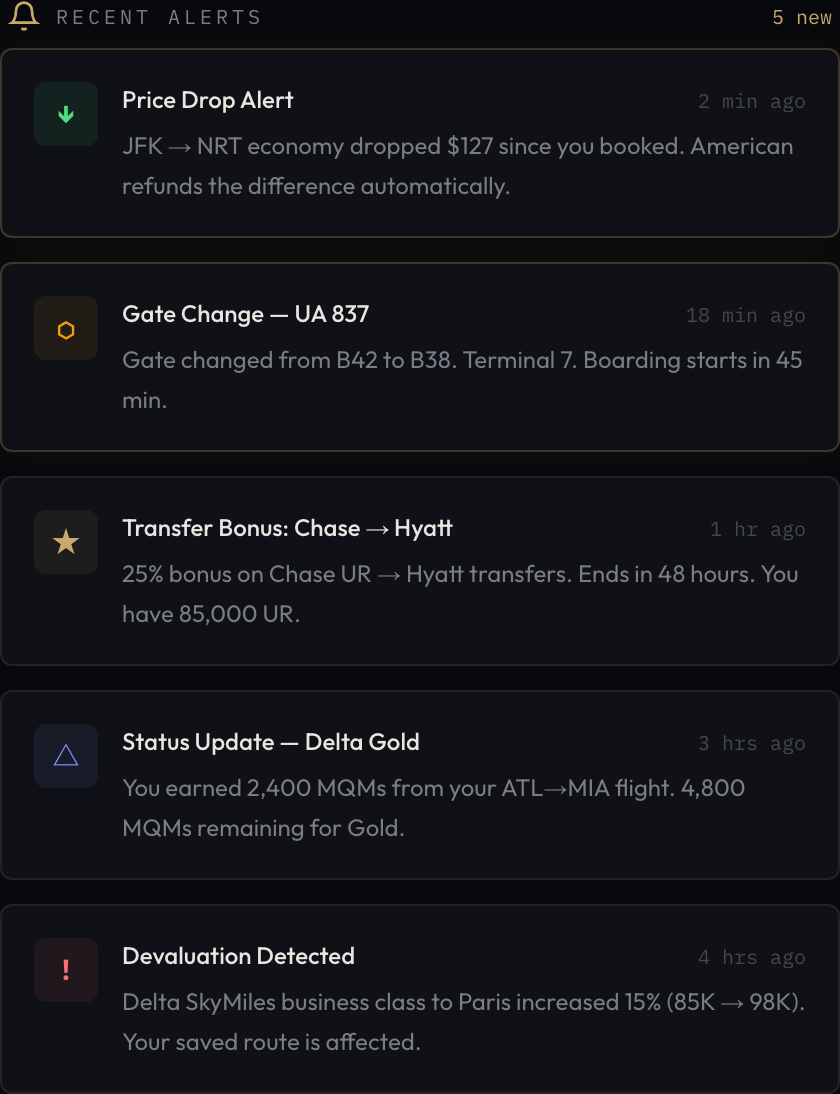
Right now I'm building what I'm calling a devaluation confidence score. When our pipeline flags anomalous pricing, instead of a binary alert/no-alert decision, it now outputs a score from 0 to 100 based on four signals:
- How many routes are affected (isolated vs. systemic)
- Whether the change affects a single cabin class or multiple
- Whether the percentage change exceeds our historical noise threshold (currently 11.3%)
- Whether the tier structure itself has changed (new logic, wasn't there before)
A score above 70 triggers an immediate push notification. A score between 40 and 70 queues a "watch" alert that we surface in the dashboard without pushing. Below 40, it logs and waits.
The Aeroplan situation would have scored an 84 under this model. It would have gone out May 20th, not May 23rd.
I'm also adding what I'm calling a book-before window: when a devaluation is detected with a future effective date, the alert explicitly surfaces the deadline. "Aeroplan prices increase June 1. You have 11 days to book at current rates." That's the sentence that would have actually helped someone.

The Numbers From This Month
What This Taught Me About Building in Public
I've been writing these posts for a few months now. The transfer graph post, the merger tracking post, the concierge. Most of them are about things that worked. This one is different, and honestly it was harder to write.
The temptation when something goes wrong is to either hide it or frame it as a learning moment so quickly that you skip past the actual failure. I want to resist that. We had the data. We didn't act on it in time. Some Aeroplan holders who were watching MileIntel for exactly this kind of alert didn't get the warning they needed.
That's a real cost, even if it's hard to quantify.
The confidence scoring system is in staging now. I'm hoping to ship it in the next two weeks, though I said "two weeks" about the transfer graph and it took five. So: sometime before July, with high confidence.
If you hold Aeroplan points and want to understand what the new 5-tier structure means for your specific balance, our miles calculator can give you a current cpp (cents per point) estimate based on your target routes. It's free, no account needed.
And if you've been burned by a devaluation you didn't see coming, I'd genuinely like to hear about it. What program? How much notice did you get? What would have actually helped? Reply to this post or find me on X. I'm building the alert system I wish existed — and I'd rather build it around real scenarios than hypothetical ones.
What's the devaluation that hurt you most?
Frequently Asked Questions
What happened to Aeroplan award prices in May 2024?
On May 20th, Air Canada Aeroplan restructured its entire award chart from 3 pricing tiers to 5 tiers. Business class awards to Europe on partner airlines jumped 20 to 37.5% overnight, with the full update announced June 1st. Users had less than 12 days' notice, with the announcement buried in a program update email most subscribers never opened.
Why did the author's devaluation alert system fail to catch Aeroplan in time?
The system detected individual route price anomalies on May 19th but misinterpreted them as targeted partner adjustments rather than a structural chart overhaul. Because the tier architecture itself changed, comparing current prices to historical prices within the old tier structure was meaningless. The author lacked decision logic to escalate uncertain signals into user-facing alerts, resulting in a 72-hour delay.
What's the difference between data detection and actionable intelligence in devaluation alerts?
Data detection flags anomalies in pricing—like individual route increases. Actionable intelligence surfaces the broader context that matters to users—like 'the entire chart restructured and you have a narrow window to book at old rates.' The author's system excelled at the former but failed at the latter, catching the signal but missing the story.
How much notice did Aeroplan users get before the devaluation?
Most users had less than 12 days between the initial May 20th expansion and the full June 1st chart update. The announcement was buried in a program update email that most subscribers never opened, making the actual notice period even shorter for those who acted on the information.
Get articles like this in your inbox
The Mileage Run — one short email when something actually changes your travel math. No filler, no affiliate trash, no spam. Unsubscribe anytime.