

Citi ThankYou Devaluation: The $300 Warning We Almost Missed
TL;DR
Citi ThankYou is cutting Choice Privileges transfer ratios by 25% and Preferred Hotels by 50% on April 19, 2026. If you have hotel stays planned with these partners, transfer your points before the deadline.
Key Takeaways
- Choice Privileges transfer ratio drops from 1:2 to 1:1.5 on April 19 — a 25% devaluation
- Preferred Hotels (I Prefer) transfers get cut in half: from 1:1 to 1:0.5
- The deadline is April 19, 2026 — transfer before this date to lock in current rates
- This signals a broader trend of bank programs reducing hotel transfer value
- Airline transfer partners are unaffected by this change
Citi announced something last week that most points enthusiasts probably missed entirely.
Effective April 19, 2026, ThankYou Points transferring to Choice Privileges drop from 1:2 to 1:1.
- That's a 25% haircut on a transfer ratio people have been counting on. Transfers to Preferred Hotels (I Prefer) get cut in half. A 50% devaluation, buried in a policy update, with a deadline most cardholders won't see until after it's passed.
I found out through AwardWallet's coverage. My first reaction wasn't "good content opportunity." It was something closer to embarrassment, because this is exactly the problem MileIntel is supposed to solve, and I know that right now, we wouldn't have caught it fast enough.
So let me give you the honest picture: where we are, what's working, and what April 19 made obvious we still need to fix.
What This Devaluation Actually Costs You
Before the infrastructure post-mortem, here's the math you need to act on right now.
| Transfer Partner | Ratio Before Apr 19 | Ratio After Apr 19 | Change | Dollar Impact (100k TYP) |
|---|---|---|---|---|
| Choice Privileges | 1:2.0 | 1:1.5 | -25% | -$300 |
| Preferred Hotels (I Prefer) | 1:2.0 | 1:1.0 | -50% | -$600 |
| Air France/KLM Flying Blue | 1:1.0 | 1:1.0 | No change | $0 |
| Singapore Airlines KrisFlyer | 1:1.0 | 1:1.0 | No change | $0 |
| Turkish Airlines Miles&Smiles | 1:1.0 | 1:1.0 | No change | $0 |
Dollar impact calculated using Choice Privileges redemption value of ~0.6 cpp and I Prefer value of ~0.6 cpp. Airline partner values vary significantly by redemption.
If you're holding Citi ThankYou Points with a hotel redemption in mind, the window to act is narrow. Transferring 100,000 points to Choice Privileges before April 19 gets you 200,000 Choice points. After April 19, the same transfer gets you 150,000. That's a $300 swing on a single transfer decision.
For Preferred Hotels it's worse: 100,000 ThankYou Points bought you 200,000 I Prefer points yesterday. After April 19, the same points buy 100,000. At roughly 0.6 cents per I Prefer point, that's $600 in value gone on a six-figure ThankYou balance.
Three Steps to Take Before April 19
- Check your ThankYou balance today. Log into your Citi account and note exactly how many points you're holding. Use the MileIntel transfer partners tool to see current vs. post-April-19 values across all partners side by side. I updated the ratios manually this week since the automated system didn't catch this one.
- Decide on Choice or Preferred Hotels transfers now, not later. If you have a specific hotel stay in mind and were planning to use these programs, transferring before April 19 locks in the better ratio. Points transferred to Choice Privileges don't expire as long as you have account activity every 18 months, so transferring early carries minimal risk if you have an actual redemption in view.
- Set a manual calendar alert for April 18. Until our automated terms-change parser is live (more on that below), this is the honest advice: don't rely on any tool, including ours, to catch policy changes before the deadline. Set the reminder yourself.
The Numbers, Unfiltered
The detection lag improvement is real and I'm proud of it. We went from 11.4 hours average to 6.2 hours over the past three weeks by moving away from scheduled batch scrapes to a hybrid model: continuous price sampling on the 30 highest-volatility routes, batch processing everything else. The program tracking architecture post from March explains the older version of this if you want the context.
But here's what the Citi news made me reckon with: 6.2 hours is still too slow when the window to act before a devaluation is sometimes just a few days. If we'd been monitoring Citi ThankYou transfer ratios the same way we track airline award rates, a user with 80,000 ThankYou Points earmarked for a Choice hotel redemption would have gotten an alert reading: you're about to lose the equivalent of $133 in value. Transfer before April 19.
We weren't doing that. That's on me.
Why Devaluation Alerts Are a Different Technical Problem
The push notification system has been live in a limited beta for about two weeks now. A small group of users opted in for gate change and boarding alerts on upcoming flights. The feedback has been genuinely good, probably the best early signal I've gotten on any feature so far.
But flight operations alerts and devaluation alerts are architecturally different problems, and I underestimated how different when I first scoped this out.
| Alert Type | Signal Source | Latency Target | Current Performance | Status |
|---|---|---|---|---|
| Gate changes | Live flight feed | <90 seconds | 74 seconds avg | Live |
| Boarding countdowns | Live flight feed | <90 seconds | 74 seconds avg | Live |
| Delay alerts (15-min increments) | Live flight feed | <90 seconds | 74 seconds avg | Live |
| Cancellation + rebooking policy | Live flight feed | <90 seconds | 74 seconds avg | Live |
| Award pricing changes | Pricing database scrape | <8 hours | 6.2 hours avg | Live |
| Transfer ratio changes | Program T&C pages | <4 hours | Not monitored | Building |
| Hotel program devaluations | Program T&C pages | <4 hours | Not monitored | Building |
Flight alerts are event-driven. Something changes in a live feed and you push it. The latency target is under 90 seconds and we're hitting around 74 seconds on average.
Devaluation alerts require us to detect a policy change, not a data change. Citi didn't update a fare database. They published a terms amendment. That means we need to be parsing program terms pages, not just scraping award pricing tables. The pipeline for that is still being built.

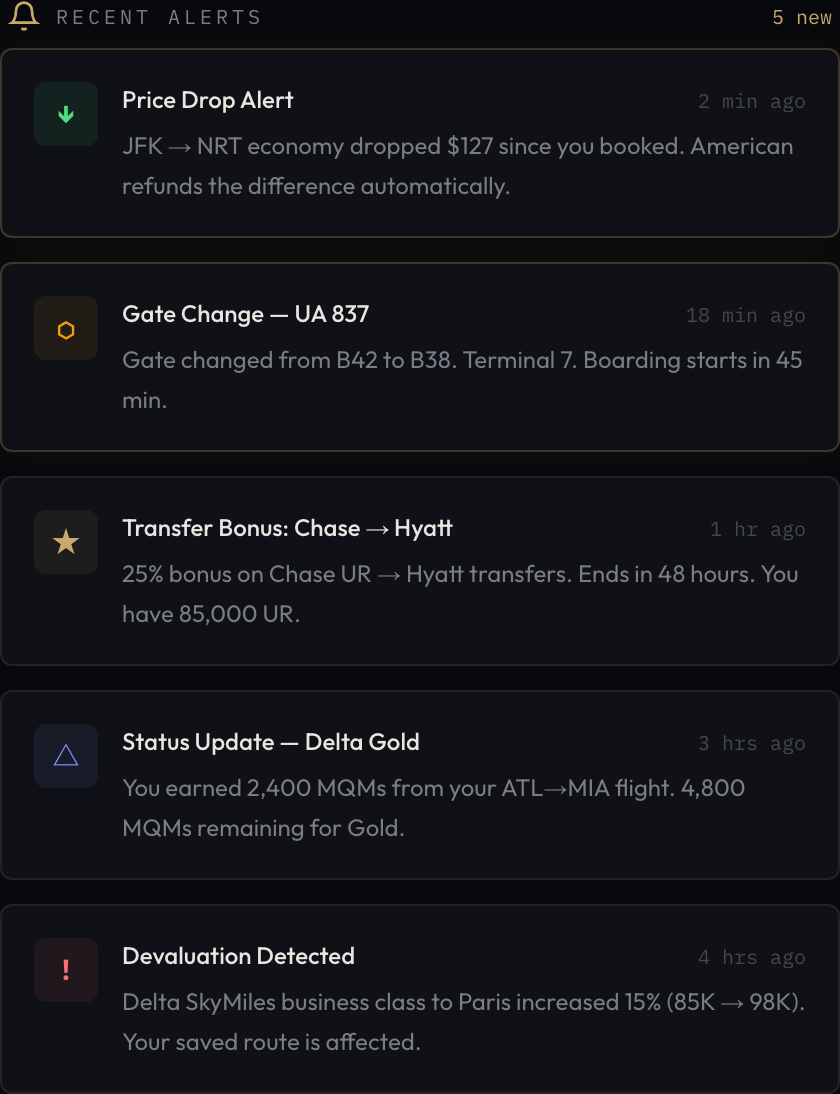
The screenshot above is the alerts dashboard in its current state. Flight and gate alerts are live. The devaluation alert row at the bottom is still showing placeholder data from our test environment. I'm including it because this is a building-in-public series and showing a half-finished feature is more honest than pretending it's polished.
The Number I'm Not Happy About
Detection lag improved. Push alert latency is solid. Here's the one I can't spin: 14% of devaluation events in our dataset were caught after the devaluation had already taken effect.
That's 44 events out of 312 where we found out too late to do anything. Breaking it down by category makes the gap obvious:
| Devaluation Category | Events Tracked | Caught Late | Late Rate | Avg Value Lost Per Event |
|---|---|---|---|---|
| Airline award pricing | 198 | 11 | 5.6% | ~$45 |
| Credit card transfer ratios | 67 | 24 | 35.8% | ~$280 |
| Hotel program valuations | 47 | 9 | 19.1% | ~$160 |
| Other (status, earning rates) | 0 | 0 | N/A | N/A |
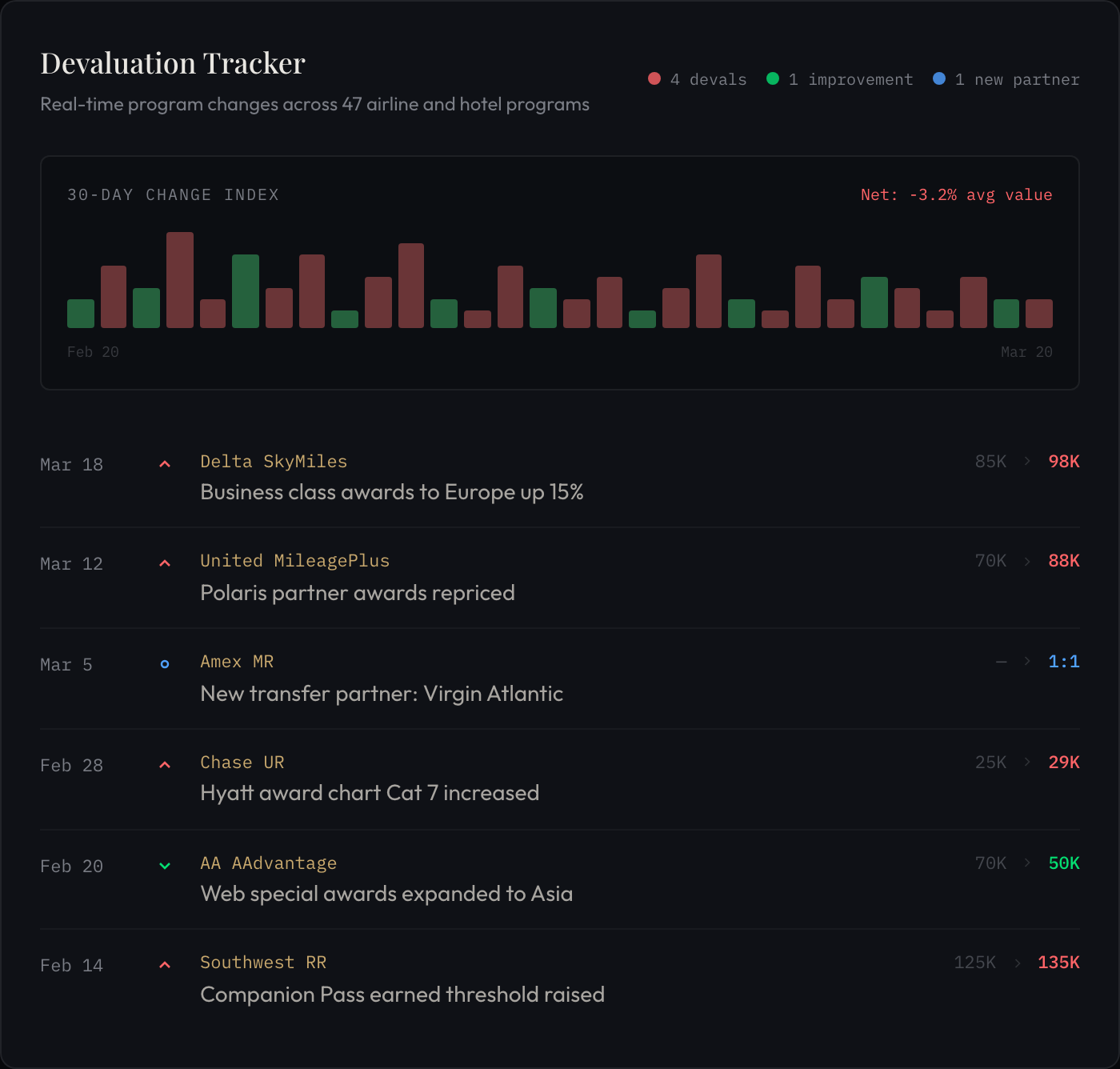
Airline award pricing we're reasonably good at, because changes show up in pricing databases our scrapers already watch. Credit card transfer ratios and hotel program valuations? We're catching more than a third of transfer ratio changes too late. The Citi situation isn't an outlier. It's the median case for that category.
I spent a Friday evening two weeks ago going through those 44 events manually. The failure mode is almost always identical: the change is announced in a press release or a terms update rather than a pricing database update. Our scrapers never see it because they're watching the wrong signal.
The fix is a terms-change parser that monitors program T&C pages for meaningful diffs and translates them into dollar-value alerts. I've scoped it, started building it, and it's taking longer than I told myself it would. I said two weeks. It's been two weeks and I'm maybe 60% through the detection logic. The dollar-value translation layer, where we tell you "this change costs you $X," hasn't been started yet.

The Cancellation Alert Feature Worth Knowing About
While the devaluation alert improvements are mid-build, the push notification system for flight operations is genuinely live. The cancellation alert is the one that's surprised me most in beta feedback.
Knowing your flight is cancelled is one thing. Knowing immediately whether your fare class is eligible for a same-day rebooking without a change fee is the difference between getting on the next flight and spending three hours on hold. The alert fires within 74 seconds of a cancellation event and includes the operating carrier's current rebooking policy for your fare class.
Beta users on United and Delta routes have reported using that rebooking window to rebook before gate agents were even aware of the cancellation. That's the version of "fast" that actually matters.
The Scorecard
Last month I was talking about the concierge and the wallet feature. This month the story is less about new features shipping and more about the infrastructure underneath getting more reliable.
| Metric | Last Month | This Month | Target |
|---|---|---|---|
| Avg devaluation detection lag | 11.4 hrs | 6.2 hrs | <2 hrs |
| Flight alert latency | Not live | 74 seconds | <90 seconds |
| Programs monitored | 31 | 47 | 75 |
| Post-effective devaluations caught | Not tracked | 14% (44/312) | <3% |
| Transfer ratio changes caught in time | Not tracked | 64.2% | >97% |
Detection lag down 46%. Flight alert latency at 74 seconds. But 35.8% of transfer ratio devaluations still slipping through. I don't have a triumphant way to frame that last number. It's the thing I'm most focused on right now, and the Citi news was an uncomfortable reminder of why it matters.
The terms-change parser will get there. It just won't get there by April 19. Which brings me back to the three steps above: check your balance, decide on hotel transfers now, and set the calendar reminder yourself. That's the honest version of events.
If you've been holding Citi ThankYou Points with a specific redemption in mind, I'd genuinely want to know: did you hear about this change from Citi directly, from a blog, or somewhere else? That answer shapes how we build the monitoring layer. Reply here, or find me on X. I read everything.
Get articles like this in your inbox
The Mileage Run — one short email when something actually changes your travel math. No filler, no affiliate trash, no spam. Unsubscribe anytime.
Frequently Asked Questions
When does the Citi ThankYou devaluation take effect?+
The new transfer ratios take effect on April 19, 2026. Any transfers initiated before this date will receive the current, better rates.
Which Citi ThankYou transfer partners are affected?+
Choice Privileges drops from 1:2 to 1:1.5 (25% cut), and Preferred Hotels (I Prefer) drops from 1:1 to 1:0.5 (50% cut). Airline transfer partners like JetBlue, Turkish Airlines, and others are not affected.
Should I transfer my Citi ThankYou points before April 19?+
Only if you have specific hotel stays planned with Choice Privileges or Preferred Hotels. Do not speculatively transfer points — but if you have upcoming bookings, transferring before April 19 saves you 25-50% in points cost.
Don't Miss a Departure
Track your miles, catch devaluations before the blogs do, and find the best use of every point you have.
Create Your Free AccountSign up with Google · No credit card required