

The Alert I Wish Existed Last Week (Building It Now)
If you follow points news at all, you already know what happened with World of Hyatt this month.
They expanded their award chart from 3 demand tiers to 5. Peak nights at top properties jumped by as much as 67%. A Category 1–7 system that members had spent years learning, memorizing, and building redemption strategies around — quietly overhauled, with the full annual category change list dropping right alongside it.
And most Hyatt members found out on Reddit. Or from a blog post. Or, worst case, when they went to book and the price was just... different.
I've been thinking about this all week. Not just because it's a big deal for Hyatt loyalists, but because it's the exact scenario that made me want to build MileIntel in the first place. The window to book at legacy rates was open. Then it closed. And the people best positioned to act were the ones who happened to be paying close attention at the right moment.
That's not a system. That's luck.
The Fork I've Been Staring At
For the past six weeks, I've been wrestling with a product decision that sounds simple but has kept me up more nights than I want to admit.
When a devaluation event is detected — something like what Hyatt just did, or the Citi ThankYou situation I wrote about in April — what should MileIntel actually do with that information?
Option A was the obvious one: send a push notification. Alert fires, user sees it, user decides what to do. Clean. Predictable. Easy to build. I had the notification infrastructure mostly in place already from the push alert system I'd been working on.
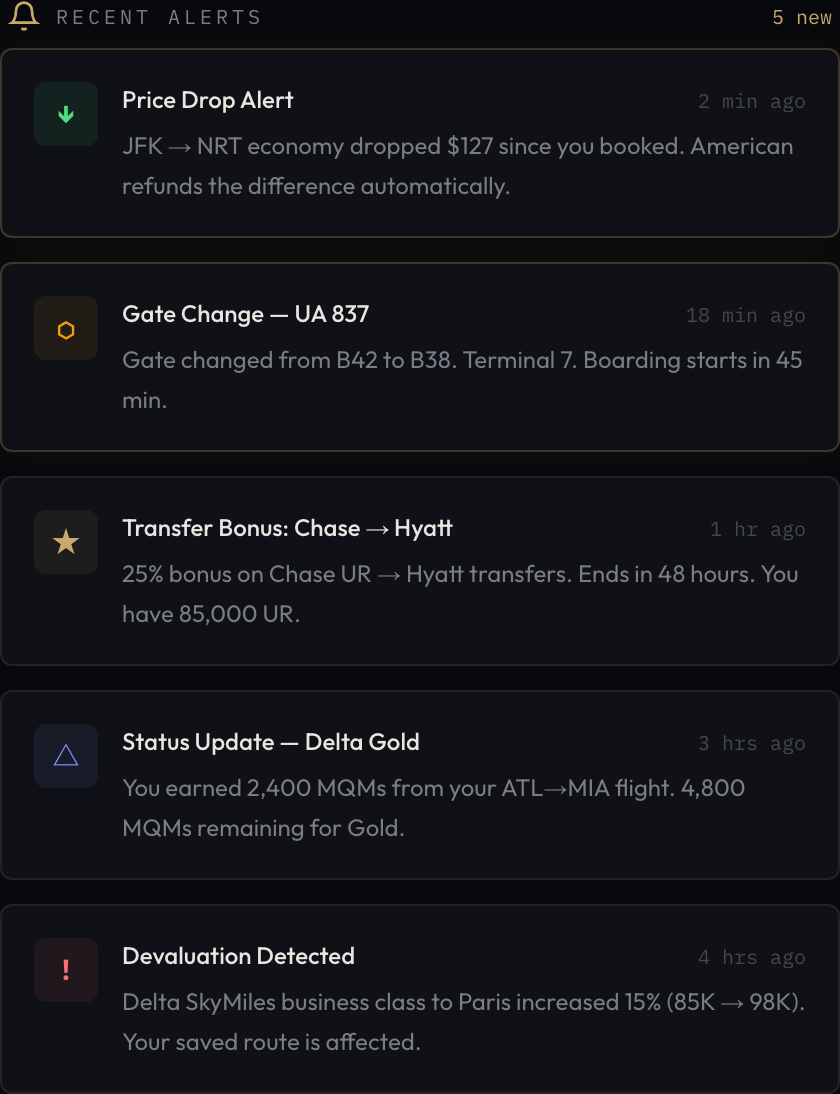
Option B was more ambitious: don't just alert the user that a devaluation happened. Alert them before the window closes, tell them specifically which of their points are affected, calculate how much value they're about to lose in dollar terms, and surface a direct booking link if there's still time to act at the old rate.
The difference sounds incremental. It isn't.
Option A tells you the house is on fire. Option B tells you the house is on fire, hands you an extinguisher, and points at the specific room.

Why Option A Was Tempting
Honestly? Because I could ship it in two weeks.
I already had the anomaly detection pipeline running. The IsolationForest model was flagging unusual award rate changes across programs. The push notification infrastructure was wired up. Option A was basically: connect those two things, write some copy, deploy.
And there's a real argument for it. A simple, reliable alert that always fires when something changes is more trustworthy than a complex one that sometimes gets the dollar calculation wrong. Alert fatigue is a real problem. If users get a notification that says "Hyatt devalued peak awards by up to 67%, your 80,000 points are now worth $127 less at Park Hyatt properties" and that math is slightly off, I've broken trust.
I spent two days seriously planning the Option A build. I even started writing the notification templates.
Then the Hyatt news dropped, and I watched the reaction play out in real time across FlyerTalk, Reddit, and a few newsletters I follow. The people who were upset weren't just upset that the devaluation happened. They were upset that they had bookings they wanted to make at specific properties, and they didn't know to make them before the cutoff.
That's an Option B problem. Option A wouldn't have helped them.
What I Actually Decided
I'm building Option B. But I'm building it in two phases, because I'm not willing to ship the dollar calculation until I'm confident in the math.
Phase 1, which I'm targeting for the end of this month: the alert fires with the devaluation details and the affected program. If a user has connected their loyalty accounts, the notification will include their balance in that program. No dollar estimate yet. Just: "This program changed, you have X points here, the window to act may be closing."
Phase 2, probably 6-8 weeks out: the value delta calculation. I want this to use the same cents-per-point methodology we've built into the miles calculator, applied against the user's specific balance, and scoped to the property categories or routes that actually changed. Not a generic "your points are worth less." A specific: "Your 90,000 World of Hyatt points bought you a peak night at a Category 7 for 45,000 points last week. That same night now costs 60,000 points at peak demand."
The reason I'm splitting it is embarrassingly simple: I got the math wrong in a test run two weeks ago. My initial value delta calculation was treating all peak nights as affected equally, but the new 5-tier system is asymmetric. Some Category 7 properties jumped hard. Others barely moved. If I'd shipped Phase 2 alongside Phase 1, I'd have been sending users incorrect loss estimates for a subset of properties.
I caught it before it went anywhere. But it reminded me how easy it is to ship something that feels precise and is actually sloppy.

The Numbers Behind the Decision
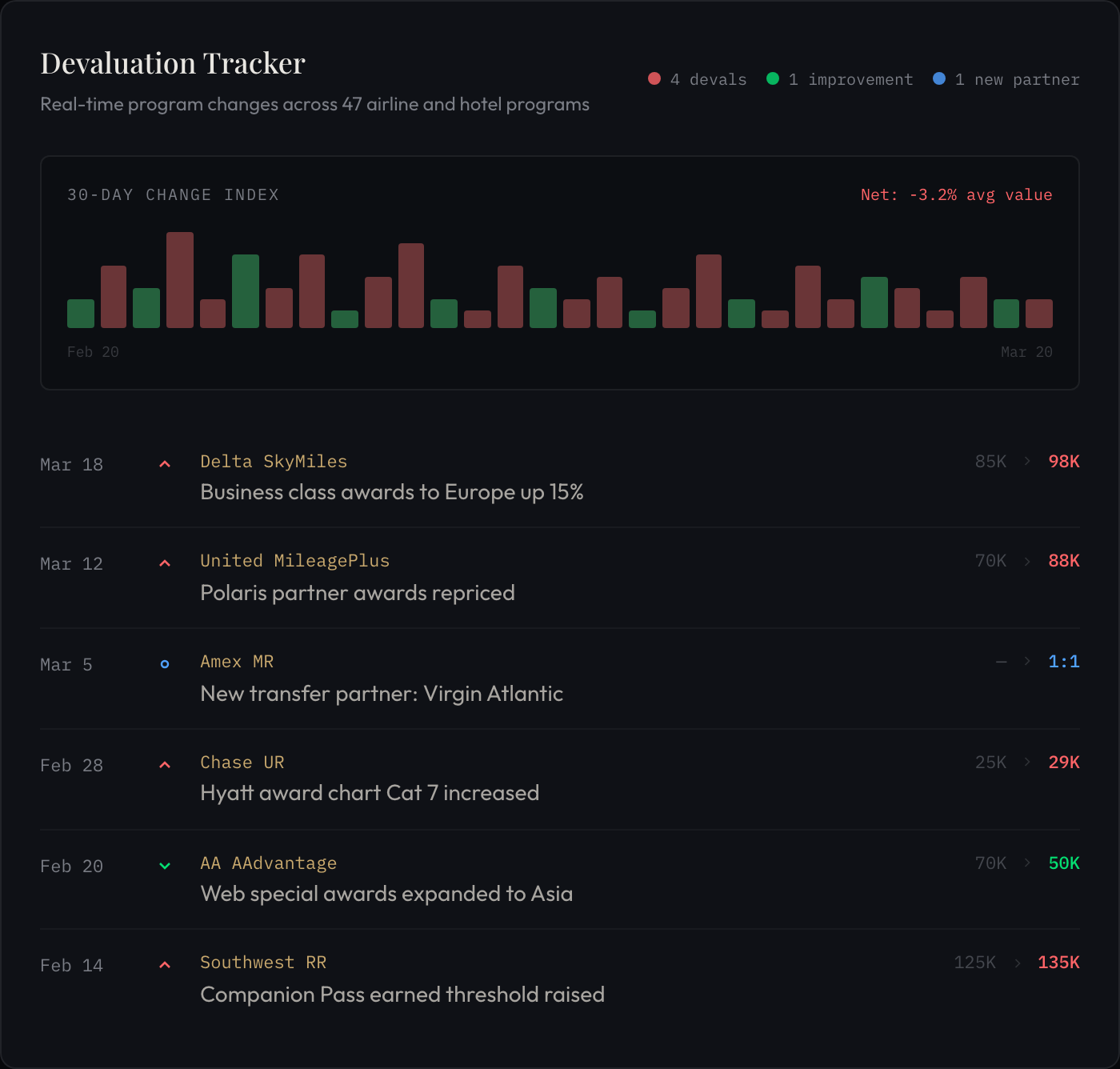
That middle number is the one that keeps me honest about which version to build. Fourteen days is not a lot of runway. An alert that fires on day 1 of that window and tells you nothing actionable is barely better than a blog post you might read on day 9.
And the third number is why I think this problem is getting worse, not better. Most programs aren't giving you a month's notice anymore. Hyatt is actually one of the more transparent ones — they published the category changes alongside the award chart overhaul. Some programs just... update the chart. You find out when you try to book.
What I Don't Know Yet
Here's the part I'm genuinely uncertain about.
I don't know if people will act on these alerts even when they're good. The Citi devaluation post from April got more reads than anything I'd written before it. But reads aren't bookings. Awareness isn't action. There's a version of this where MileIntel sends a perfect, accurate, timely alert and the user thinks "I should do something about this" and then doesn't.
I have no idea how to solve that beyond making the alert as frictionless as possible. Which is part of why I want Phase 2 to include a direct link to relevant award search pages, not just information. But I'm also aware that I'm one developer building this, and feature scope is how projects die.
So that's where I am. A decision made, a build in progress, and at least one thing I'm still not sure about.
If you've got Hyatt points sitting around right now, it's worth checking the new award chart before you plan your next redemption. The 5-tier system is live. The old Category 1–7 rates at peak properties are gone.
And if you want to be the person who knows about the next one before it closes: what would make an alert like this actually useful to you? Reply or drop it in the comments. I'm building this thing and I'd rather get it right than get it fast.
Get articles like this in your inbox
The Mileage Run — one short email when something actually changes your travel math. No filler, no affiliate trash, no spam. Unsubscribe anytime.
Don't Miss a Departure
Track your miles, catch devaluations before the blogs do, and find the best use of every point you have.
Create Your Free AccountSign up with Google · No credit card required