

Expedia Spent $279M on Acquisitions in Q1 2020, Airbnb Booked $70M Tiqets Gain
TL;DR
Expedia spent $279 million in actual cash on acquisitions in Q1 2020, while Airbnb recorded a $70 million non-cash accounting gain on its Tiqets investment—two fundamentally different financial strategies that revealed how each company was positioned to weather the COVID-19 travel crisis.
Key Takeaways
- Expedia's $279M acquisition spending in Q1 2020 was a real cash outflow, primarily for Boddy, a corporate travel technology company for its Egencia division.
- Airbnb's $70M gain was a non-cash balance-sheet revaluation of its minority stake in Tiqets, not a new investment or sale.
- Both transactions closed in Q1 2020, the same quarter COVID-19 began shutting down global travel, creating vastly different financial impacts.
- Cash-based acquisitions drain liquidity during crises, while non-cash accounting gains preserve cash reserves for survival and recovery.
Expedia Spent $279M on Acquisitions in Q1 2020, Airbnb Booked $70M Tiqets Gain
Expedia Group spent $279 million in real cash on acquisitions in Q1 2020, while Airbnb reported a $70 million non-cash accounting gain on its Tiqets investment — two radically different financial strategies that faced very different stress tests when COVID-19 hit weeks later.
The headline numbers look similar at first glance. One company spent big. Another company gained big. But the nature of those dollars could not be more different, and understanding that distinction tells you almost everything about how Expedia and Airbnb were built to survive (or not survive) the worst travel crisis in a century.
What Changed
- Expedia Group disclosed in an SEC filing that it spent $279 million on acquisitions during Q1 2020, with a significant portion attributed to the purchase of Boddy, a corporate travel technology company aimed at strengthening its Egencia business travel division.
- Airbnb reported a non-cash gain of approximately $70 million in early 2020, stemming from an accounting revaluation of its existing minority stake in Tiqets, a tours-and-activities booking platform.
- Airbnb had led a $60 million Series C funding round for Tiqets in October 2019, according to TechCrunch's contemporaneous reporting. The $70 million gain was not a sale or new investment; it was a mark-to-market revaluation of that prior stake.
- Both transactions occurred in Q1 2020, the same quarter in which COVID-19 began shutting down global travel. Expedia's Q1 2020 earnings, reported by PhocusWire, confirmed the company absorbed a massive revenue hit in the same period these acquisitions closed.
- Expedia's $279 million was a cash outflow; Airbnb's $70 million was a balance-sheet entry with no cash changing hands.
Why It Matters: The Part Other Coverage Missed

Most reporting at the time framed these as parallel financial events: two travel giants making moves. That framing misses the most important detail. Expedia's $279 million left the building. It was real capital deployed for full ownership and integration of a target company. Airbnb's $70 million never existed as cash. It was an accountant's estimate of what a minority stake in a private company was worth at a specific moment in time.
That moment, as it turned out, was the peak of the pre-pandemic private investment bubble. The tours-and-activities sector, which Tiqets operates in, was one of the hardest-hit corners of travel when lockdowns began. A paper gain recorded in Q1 2020 on a tours platform almost certainly reversed into a paper loss by Q2 2020, when in-person experiences globally went to near-zero. Airbnb never disclosed a subsequent write-down of the Tiqets stake publicly, but the economic logic is straightforward: a $70 million upward revaluation of a tours business in January 2020 is a very different asset than the same stake in April 2020.
Expedia's situation carries its own irony. Acquiring corporate travel technology right before business travel evaporated for 18-plus months is a case study in timing risk. Egencia, the corporate travel arm Boddy was meant to strengthen, was eventually sold to American Express Global Business Travel in 2021. Whether the Boddy acquisition ever delivered its intended strategic value before that sale is a question Expedia's subsequent filings do not cleanly answer.
Who Was Most Affected, and by How Much
This story is less about loyalty program members and more about the corporate strategies that shape which travel platforms survive to offer rewards in the first place. Here is a direct comparison of the two transactions:
| Item | Expedia Group | Airbnb |
|---|---|---|
| Transaction type | Direct acquisition (cash) | Investment revaluation (non-cash) |
| Amount | $279 million spent | $70 million gain (paper) |
| Target | Boddy (corporate travel tech) | Tiqets (tours & activities) |
| Ownership result | Full control, integration | Minority stake, no control |
| Cash impact | Negative $279 million | Zero |
| Sector timing | Business travel (evaporated 18+ months) | Experiences (near-zero in lockdowns) |
| Strategic outcome | Egencia sold to Amex GBT in 2021 | Tiqets stake value likely reversed |
For travelers and loyalty program participants, the downstream effect is real. Expedia's aggressive acquisition strategy during this period contributed to the debt load that forced the company into a significant restructuring in 2020, including laying off roughly 3,000 employees. A leaner Expedia with less acquisition appetite means fewer competitive pressures on hotel and flight pricing, which ultimately affects the value of points you redeem through Expedia's platform or its partners.
Airbnb's lighter-touch investment strategy, by contrast, preserved cash ahead of its December 2020 IPO. That IPO raised $3.5 billion and gave Airbnb the runway to invest in its core platform rather than integrating acquired companies during a crisis. If you use Airbnb for travel and care about the platform's long-term health, the $70 million non-cash gain is a footnote. The cash preservation strategy behind it is the real story.
What This Looks Like in 6 Months (and What History Says)
This analysis covers events from Q1 2020, so the "6-month" window is now historical record. What actually happened is instructive for evaluating any large travel-sector acquisition made at a market peak.
Expedia's Q2 2020 revenue fell approximately 82% year-over-year, according to the company's subsequent earnings filings. The Boddy acquisition, designed to capture corporate travel growth, became a stranded asset almost immediately. Egencia's eventual sale to Amex GBT in 2021 suggests Expedia concluded that owning corporate travel infrastructure outright was not worth the capital commitment in a post-pandemic world where business travel recovery lagged leisure by years.
The pattern here echoes a broader truth about travel M&A at cycle peaks: acquirers pay full price for assets that are priced for continued growth, then absorb the full downside when the cycle turns. Minority investors like Airbnb, holding paper stakes rather than integrated subsidiaries, can write down a balance-sheet line without the operational drag of a company they now own and must run.
For the loyalty and travel rewards ecosystem specifically, this matters because platform financial health determines program generosity. Expedia Rewards (now One Key) went through multiple restructurings in the years following 2020. Understanding why requires understanding the capital allocation decisions made in Q1 2020.
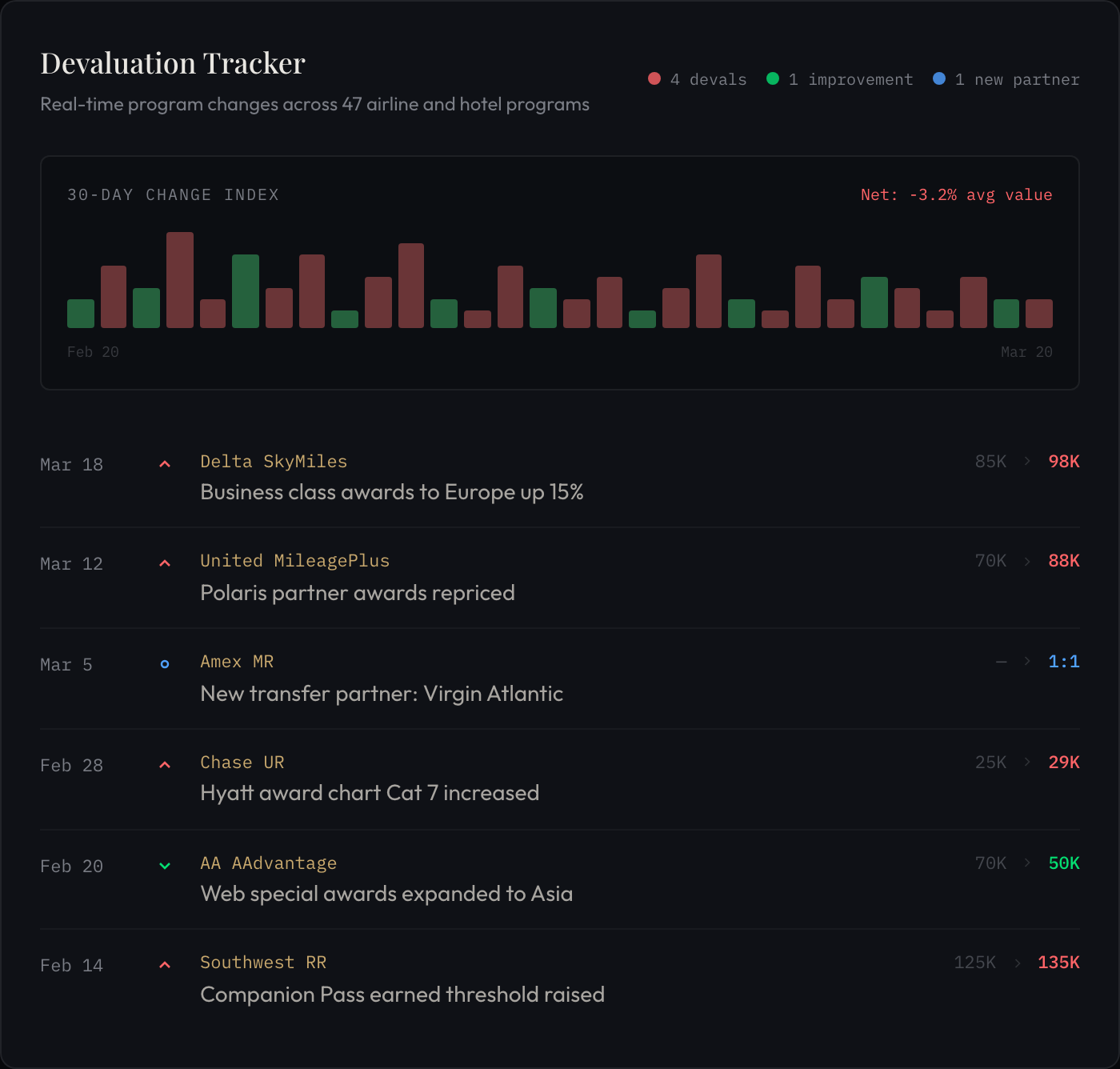
If you track program devaluations and want to anticipate which platforms are under financial pressure, watch SEC filings for acquisition spending relative to free cash flow. A company spending heavily on acquisitions while revenue is declining is a program at higher devaluation risk. Use our devaluation tracker to monitor changes across major programs as they happen.
How This Connects to the Loyalty Programs You Actually Use
Expedia's One Key program, which consolidates Expedia, Hotels.com, and Vrbo rewards, is a direct descendant of the strategic choices made in this period. The program's structure reflects a company that over-extended on acquisitions and then had to rationalize its portfolio. If you hold One Key Cash or are evaluating whether to concentrate your hotel bookings through Expedia's ecosystem, the platform's financial history is relevant context.
For hotel loyalty specifically, the question of whether to book direct (earning Marriott Bonvoy, Hilton Honors, or World of Hyatt points) versus booking through Expedia (earning One Key Cash) is a recurring one. Our Marriott Bonvoy guide and World of Hyatt guide break down the direct-booking value proposition in detail. The short answer: direct bookings almost always win on points value and elite night credits, but Expedia's platform discounts occasionally close the gap.
Airbnb does not operate a traditional loyalty program, which is itself a strategic choice consistent with the capital-light investment philosophy visible in the Tiqets transaction. The company has experimented with loyalty features but has not launched a points-based program as of this writing. For travelers who split stays between hotels and Airbnb, that means your Airbnb spend earns nothing transferable. Pairing a strong transferable points card (see our Chase Ultimate Rewards guide or Amex Membership Rewards guide) with Airbnb bookings is the best workaround available.
If you are comparing which hotel program deserves your concentration, our Marriott Bonvoy vs. World of Hyatt comparison is a good starting point for understanding where your spend earns the most.
What to Do in the Next 7 Days
- If you hold Expedia One Key Cash (by end of this week): Check your balance expiration date at expedia.com/rewards. One Key Cash expires 12 months after earning. Given Expedia's history of program restructuring, do not let balances age. Redeem toward a confirmed booking now rather than banking for a future trip.
- If you book experiences through platforms like Tiqets, Viator, or GetYourGuide (by end of this week): Audit which credit card you use for these purchases. Most travel cards do not code tours and activities as a bonus category. The Chase Sapphire Reserve codes them as travel (5x on portal, 3x direct); the Amex Platinum does not. Switching your experiences spend to the right card could add 1-2 cents per dollar in value. See our best use of Chase points tool to model the difference.
- If you are evaluating whether to book hotels through Expedia vs. direct (this week): Run a side-by-side on your next hotel stay. Take the Expedia price, subtract the One Key Cash you would earn (typically 2-10% depending on tier), and compare it to the direct rate plus the points you would earn toward your hotel program. Our miles calculator can help you put a dollar value on those hotel points.
- If you track travel platform financial health for program devaluation risk (ongoing, start today): Bookmark Expedia Group's SEC filings page (sec.gov, search "Expedia Group") and set a calendar reminder to check their next 10-Q for acquisition spending and free cash flow. A company spending more than it earns on acquisitions while revenue is under pressure is a program that will eventually cut redemption values to protect margins.
- If you are deciding between transferable points currencies (this week): The Expedia/Airbnb story is a reminder that platform-specific rewards (One Key Cash, Airbnb credit) carry concentration risk. Transferable currencies like Chase Ultimate Rewards and Amex Membership Rewards give you optionality across airlines and hotels regardless of which OTA is struggling. Our Chase UR vs. Amex MR comparison lays out which currency wins for your specific travel patterns.
Sources
- Expedia Spent $279 Million on Acquisitions in Q1, Airbnb Gained $70 Million on Tiqets Deal: Scoop — Skift (primary reporting, May 21, 2020)
- Tiqets raises $60M led by Airbnb to help travelers book last-minute tours and activities on mobile — TechCrunch (primary source for October 2019 Series C details)
- Expedia Group sees massive first quarter hit from COVID-19 — PhocusWire (Q1 2020 earnings context and corroboration)
Frequently Asked Questions
How much did Expedia spend on acquisitions in Q1 2020?+
Expedia Group spent $279 million in cash on acquisitions during Q1 2020, with a significant portion attributed to the purchase of Boddy, a corporate travel technology company aimed at strengthening its Egencia business travel division.
What was Airbnb's $70 million gain in Q1 2020?+
Airbnb reported a non-cash gain of approximately $70 million in early 2020 from a mark-to-market revaluation of its existing minority stake in Tiqets, a tours-and-activities booking platform. This was not a sale or new investment, but an accounting revaluation of Airbnb's prior $60 million Series C investment from October 2019.
Why does the difference between cash and non-cash gains matter for travel companies?+
Cash-based acquisitions like Expedia's $279M spending drain actual liquidity from the company's reserves, leaving less cash available to weather crises. Non-cash accounting gains like Airbnb's $70M revaluation preserve cash reserves on the balance sheet, providing greater financial flexibility during emergencies like the COVID-19 travel shutdown.
Don't Miss a Departure
Track your miles, catch devaluations before the blogs do, and find the best use of every point you have.
Create Your Free AccountSign up with Google · No credit card required