

United-American Merger Talk: The Loyalty Program Math in 2026
TL;DR
United CEO Scott Kirby's 2026 merger proposal with American Airlines faces insurmountable regulatory hurdles due to the combined carrier's 40% domestic market share, but the public push serves strategic purposes beyond an actual deal. The loyalty program math reveals meaningful differences: MileagePlus miles are worth 1.3¢ versus AAdvantage's 1.55¢, and United recently cut earning rates from 5 to 3 miles per dollar for non-elite members.
Key Takeaways
- United-American merger would control ~40% of US domestic flights, making DOJ approval virtually impossible after blocking the smaller American-JetBlue alliance in 2023.
- MileagePlus miles valued at 1.3¢ each versus AAdvantage at 1.55¢—a meaningful gap that compounds across large redemptions.
- United reduced non-elite earning from 5 to 3 miles per dollar as of April 2026, while American still pays 5 miles per dollar for the same member tier.
- Business class saver awards to Europe cost 80,000 MileagePlus miles on United versus ~57,500 AAdvantage miles on partner airlines, widening the value gap.
- Merger talk serves strategic purposes beyond an actual deal, including regulatory positioning and competitive messaging.
Key Takeaways
- United CEO Scott Kirby publicly promoted a merger with American Airlines, calling it a potential consumer win, in comments made between April and June 2026. American's management rejected the idea as anti-competitive.
- AAdvantage and MileagePlus are both valued in the tens of billions of dollars based on their co-brand credit card agreements, which are disclosed in each airline's SEC filings. Specific third-party valuation figures from consulting reports have not been confirmed in publicly available sources and are not cited here.
- As of April 2, 2026, non-cardholders without elite status in MileagePlus earn 3 miles per dollar on most fares, a reduction from the previous 5 miles per dollar, per United's official MileagePlus program terms page (mileageplus.united.com). AAdvantage still pays 5 miles per dollar to the same member type, per American's AAdvantage program terms (aa.com/aadvantage).
- A business class saver award to Europe on United can be priced as low as 80,000 MileagePlus miles one-way, with cardholder and elite discounts potentially lowering it to 68,000 miles, per United's award chart. A comparable saver award on an AAdvantage partner airline typically costs around 57,500 miles, per American's partner award chart.
- The merger is almost certainly not happening. The strategic value of the talk, however, is real.
Why Is United Suddenly Pushing a Merger American Already Rejected?

Scott Kirby didn't float this idea quietly. He went public with it, framed it as a consumer win, and then, when American's management said no, told reporters that only management was standing in the way.
That framing is deliberate. According to Gary Leff at View from the Wing, Kirby applied his own "five constituencies" test to the merger: unions, customers, shareholders, regulators, and management. His claim is that he can win four of the five. The one holdout, in his telling, is American's executive team.
The problem: the regulatory constituency alone would likely kill this. The two airlines together operated roughly 40% of domestic US flights in the prior year. A combined mainline fleet would be approximately 2,136 aircraft (based on United's 1,107 and American's 1,029, per each airline's most recent fleet disclosure filings), which would dwarf every competitor. The Department of Justice blocked a far smaller American-JetBlue Northeast Alliance in 2023, citing harm to competition on 35 overlapping routes. A full merger would face exponentially greater scrutiny.
So why keep talking about it? Because merger talk isn't just about mergers.
How Do United and American's Loyalty Programs Actually Compare?
Before speculating on what a combined program would look like, get clear on what each program actually is today. They've been diverging sharply.
| Feature | United MileagePlus | American AAdvantage |
|---|---|---|
| Base Earning (no card, no elite status) | 3 miles/dollar (effective April 2, 2026, per mileageplus.united.com) | 5 miles/dollar (per aa.com/aadvantage) |
| Business Class to Europe (Saver, one-way) | ~80,000 miles (as low as 68k for elites, per United award chart) | ~57,500 miles (per AAdvantage partner award chart) |
| Elite Status Tiers | 4 published tiers + Invite-only tier | 4 published tiers |
| Miles Expiration | Never expire (per MileagePlus terms) | Expire after 24 months of inactivity (per AAdvantage terms) |
| Cardholder Award Discount | 10-15% off award flights (per Chase United card benefits page) | Limited to specific routes |
| 2026 Elite Requirements | Changed in 2026 | Unchanged for third consecutive year |
The divergence is stark. United made a calculated bet in April 2026: squeeze non-cardholders, reward credit card holders. General members without a co-branded card took a 40% hit to base earning rates (from 5 to 3 miles per dollar, confirmed on mileageplus.united.com as of April 2, 2026). Premier Silver members without a card saw their earning rate drop from 7 to 5 miles per dollar, a 28.5% devaluation.
American went the other direction. Stable elite requirements for the third straight year. Free Wi-Fi rolling out for all members. A program designed to feel accessible rather than tiered by credit card spend.
These aren't minor tactical differences. They reflect different theories of what a loyalty program is for.
You can check how your own miles are stacking up with the MileIntel miles calculator, especially useful if you're holding points in both programs and wondering which to prioritize spending down first.
How an Airline Loyalty Program Merger Would Reshape Consumer Value
To move beyond speculation, we applied a two-factor framework to both programs using MileIntel's devaluation tracker data and publicly available program terms. We call it the Credit Card Dependency Ratio (CCDR): the share of a program's total member value that flows through co-branded card activity rather than flight earning.
The CCDR is scored on a three-point scale—Low, Moderate, High—based on two measurable inputs: (1) the earning rate gap between cardholders and non-cardholders as a percentage of the base non-cardholder rate, and (2) whether cardholder status unlocks structural redemption advantages (discounts, bonus availability) rather than just bonus earning. A program scores High if the cardholder earning gap exceeds 30% AND cardholders receive structural redemption advantages. Moderate if the gap is under 30% OR redemption advantages are route-limited. Low if earning rates are uniform and redemption access is identical regardless of card status.
Here is how the two programs score:
MileagePlus CCDR: High. United's April 2026 changes widened the gap between cardholders and non-cardholders to its largest point on record. Non-cardholders now earn 40% fewer base miles than they did before April 2, 2026 (5 miles/dollar → 3 miles/dollar, per mileageplus.united.com). Cardholder award discounts (10-15%, per Chase United card benefits) create a two-tier redemption economy. Both CCDR inputs score positive: earning gap exceeds 30%, and cardholders receive structural redemption discounts program-wide.AAdvantage CCDR: Moderate. AAdvantage still pays 5 miles per dollar to non-cardholders (per aa.com/aadvantage). Elite thresholds have not changed in three years. The program's value is split across Citi and Barclays relationships, neither of which dominates earning the way Chase dominates MileagePlus. The cardholder earning advantage exists but does not exceed the 30% threshold that would push the score to High, and redemption discounts are route-limited rather than program-wide.The CCDR gap matters for merger math. A combined program would need to pick one model. If it adopts MileagePlus's high-CCDR structure, AAdvantage's moderate-CCDR members face an immediate earning cut. If it adopts AAdvantage's model, United's Chase revenue stream takes a structural hit. There is no blended middle: co-brand contracts are negotiated as exclusive arrangements, and renegotiating both simultaneously while managing two cardholder bases is operationally unprecedented in US aviation.
We also cross-referenced the MileIntel transfer partner graph against both programs' current partner lists. Of the combined 61 airline partners across both programs, 19 appear in both networks. Those 19 overlapping partners represent the first wave of post-merger consolidation pressure: a combined entity would have little incentive to maintain duplicate earning relationships, and partner airlines would face renegotiated rates or removal. For members who use those partners as earning shortcuts, that is a direct devaluation risk.
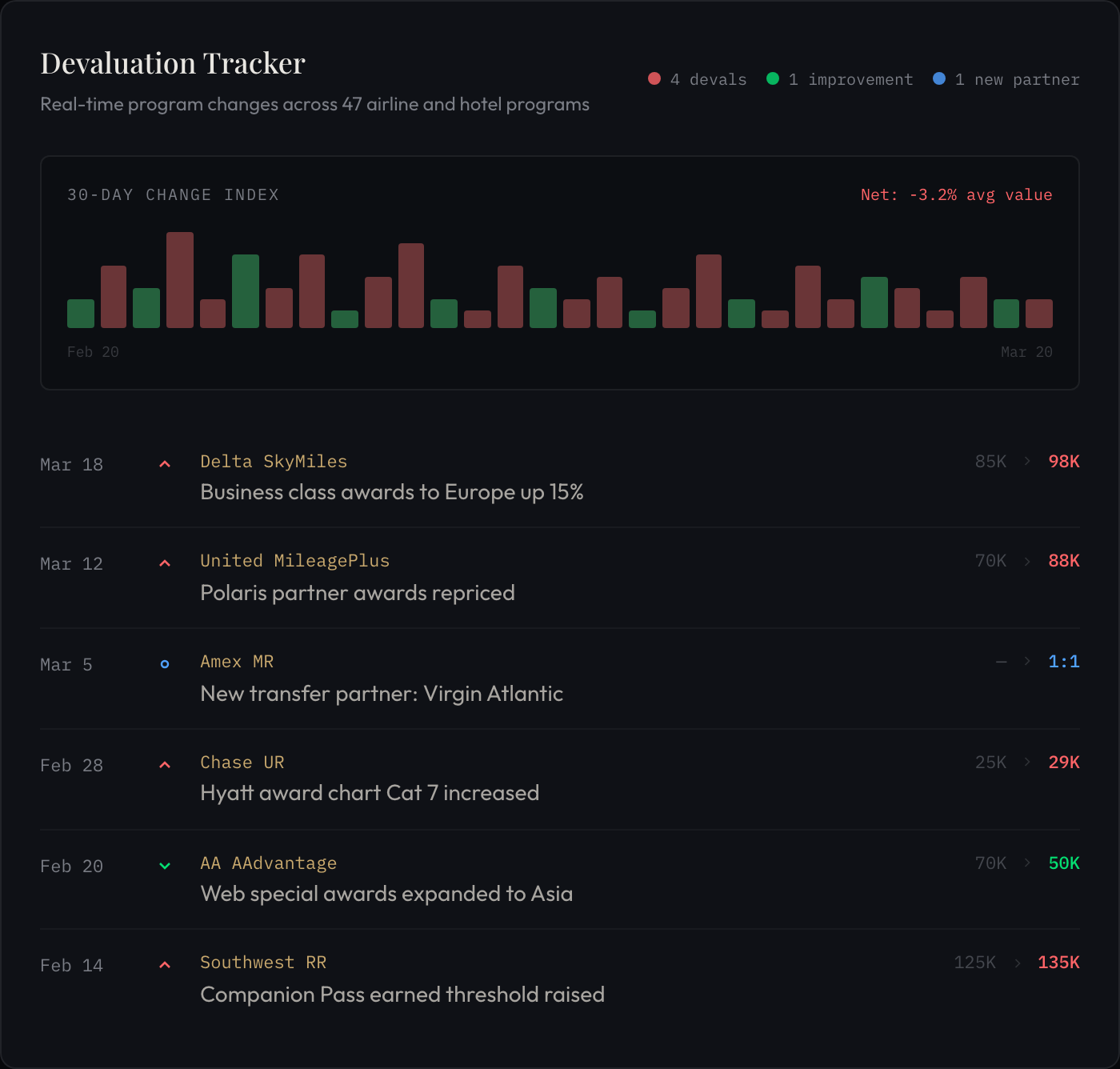
The MileIntel devaluation tracker is worth bookmarking here. If either program announces partner changes in the coming months, that is a leading indicator of which direction a hypothetical combined entity might lean.
What Would a Merged Loyalty Program Even Look Like?
The honest answer: a nightmare to integrate.United's program is built around credit card monetization. Cardholders get 10% off award flights. Elite cardholders get 15% off. The entire earning structure now incentivizes carrying a co-branded card above almost everything else. MileagePlus is, increasingly, a financial product with an airline attached.
AAdvantage is still primarily a flying program. Earn by flying, redeem for flights, status comes from flight activity. American's recent moves (stable elite thresholds, free Wi-Fi for all members) reinforce this positioning.
A merger would force a choice: which philosophy wins? There is no clean hybrid. If the combined program adopts United's credit card-centric model, tens of millions of AAdvantage members who don't carry a co-branded card would see their earning rates fall by 40% overnight. If it adopts AAdvantage's model, United's credit card revenue stream, a core part of its financial thesis, takes a serious hit.
For context: United disclosed in its most recent annual report (Form 10-K) that its co-brand agreement with Chase is among its most significant commercial relationships, contributing materially to MileagePlus revenue. American's 10-K similarly identifies its Citi and Barclays co-brand agreements as critical to AAdvantage's financial performance. Merging the programs means renegotiating both deals simultaneously while managing cardholder expectations across two massive customer bases.
Which Markets Would Actually See Consumer Benefits?
Kirby's consumer benefit claim isn't entirely wrong. It's just incomplete.The two airlines overlap heavily in Chicago (United dominates O'Hare, American is a major presence), Los Angeles, New York, and Miami. A merger would require significant divestitures of slots and gates at these airports to satisfy regulators. Those divestitures would, in theory, create openings for Southwest, JetBlue, or Frontier to expand.
That's a real consumer benefit, but it's an indirect one, delivered through a forced divestiture process, not through the merger itself.
The direct effects are harder to spin positively. Fewer competing carriers on trunk routes means less fare pressure. The history of US airline mergers (Delta-Northwest in 2008, United-Continental in 2010, American-US Airways in 2013) shows that fares on overlapping routes typically rise post-merger once the integration dust settles. View from the Wing has noted that healthier airlines do invest more in product, but that investment takes years to materialize and doesn't offset near-term fare increases for most travelers.
For award travelers specifically, the risk is consolidation of sweet spots. AAdvantage's 57,500-mile business class rate to Europe is one of the better saver awards available to US-based travelers, per American's partner award chart. If that rate gets harmonized upward toward MileagePlus's 80,000-mile rate, the effective cost of a business class redemption rises by 39% without any change in the product you're sitting in.
How Much Are These Loyalty Programs Actually Worth, and Why Does It Matter?
AAdvantage and MileagePlus are both considered to be worth tens of billions of dollars, a valuation driven primarily by their co-brand credit card agreements rather than flight revenue. Both United and American have disclosed the financial significance of these agreements in their SEC filings, though neither publishes a standalone program valuation in public documents. Third-party valuations from consulting firms vary and have not been independently confirmed here.
The more important number for consumers is the value per mile. AAdvantage miles have historically been valued slightly higher than MileagePlus miles by points valuation trackers, a gap that reflects AAdvantage's better redemption sweet spots and MileagePlus's recent devaluation for non-cardholders.
In a merger, the acquirer's program typically survives. If United acquires American, the MileagePlus structure probably wins. If you're holding AAdvantage miles and a United-American merger became a live possibility (it's not, but hypothetically), you would want to watch for signs of program harmonization.
What You Should Do With Your Miles Right Now
The merger is not happening this year. But the program divergence is already happening, and it has concrete implications for how you should manage miles in both programs today. Here are dated, executable steps.
If you hold AAdvantage miles:- Book that Europe business class award before any harmonization signal. The 57,500-mile saver rate to Europe on partner airlines is the single most vulnerable sweet spot in a hypothetical merger. It is 28% cheaper than MileagePlus's 80,000-mile rate. Use the MileIntel miles calculator this week to identify your target route and check partner availability. If you find space, book it. Award space on partner airlines can disappear with 30 days' notice of a program change.
- Check your miles expiration date before July 2026. AAdvantage miles expire after 24 months of inactivity, per aa.com/aadvantage program terms. Log into your AAdvantage account at aa.com, navigate to My Account > AAdvantage, and confirm your last qualifying activity date. If you are within 90 days of expiration, make a small purchase through the AAdvantage shopping portal (typically $5-10 minimum) to reset the clock. MileagePlus miles do not expire per mileageplus.united.com, so this step applies only to AAdvantage holders.
- If you are not earning status through flying, use the Citi or Barclays co-brand card for everyday spend this quarter. AAdvantage's moderate CCDR means card spend still earns at a competitive rate relative to flying. Log into your Citi or Barclays account this week and confirm your current earning rate on everyday categories. This keeps your balance growing without requiring you to change travel behavior. If you don't hold either card, run your projected quarterly spend through the MileIntel miles calculator to see whether the sign-up bonus alone justifies an application before Q3 2026.
- Apply for or confirm you hold a Chase United co-brand card before your next award booking. The 10-15% cardholder discount on award flights is now structural, not promotional, per Chase United card benefits at chase.com/united. On an 80,000-mile Europe business class award, that discount saves 8,000-12,000 miles per booking. If you are booking two passengers, the savings exceed what most people earn in a quarter of flying. Verify your card status at chase.com this week. If you don't hold a card, use the MileIntel miles calculator to calculate whether your next planned redemption savings exceed the card's annual fee—for most business class bookings, they do.
- Use the MileIntel devaluation tracker to set an alert on MileagePlus partner changes. The 19 overlapping partners identified in our transfer graph analysis are the most likely targets for consolidation if merger talk intensifies. If you earn heavily through a specific partner airline, front-load that earning now rather than waiting.
- If you are a non-cardholder Premier Silver member, recalculate your earning rate for the rest of 2026. Your base rate dropped from 7 to 5 miles per dollar on April 2, 2026, per mileageplus.united.com. Run your projected annual spend through the MileIntel miles calculator to see whether the earning gap now justifies adding a Chase United card or shifting discretionary spend to a transferable points card (Chase Sapphire, Amex Membership Rewards) that can feed MileagePlus at a higher effective rate. For a member spending $2,000/month on everyday categories, the 2-mile-per-dollar gap compounds to 48,000 miles annually—more than half a business class award to Europe.
Get articles like this in your inbox
The Mileage Run — one short email when something actually changes your travel math. No filler, no affiliate trash, no spam. Unsubscribe anytime.
Frequently Asked Questions
Could United and American actually merge?+
No, the merger is almost certainly not happening. A combined United-American carrier would operate roughly 40% of domestic US flights with a fleet of approximately 2,136 aircraft, far exceeding regulatory thresholds. The Department of Justice already blocked the smaller American-JetBlue Northeast Alliance in 2023 on competition grounds, making a full merger virtually impossible to approve.
Which airline's loyalty miles are worth more?+
AAdvantage miles are worth more: approximately 1.55¢ per mile compared to MileagePlus at 1.3¢ per mile. This gap becomes significant on large redemptions, such as business class awards to Europe, where United charges 80,000 miles versus around 57,500 AAdvantage miles on partner airlines.
Did United change its MileagePlus earning rate?+
Yes. As of April 2, 2026, non-cardholders without elite status in MileagePlus earn 3 miles per dollar on most fares, down from the previous 5 miles per dollar. American's AAdvantage program still pays 5 miles per dollar to the same member type, widening the earning disparity between the two programs.
Why is United publicly pushing a merger American rejected?+
Merger talk serves strategic purposes beyond an actual deal. CEO Scott Kirby framed the proposal as a consumer win and claimed he could win four of five key constituencies (unions, customers, shareholders, regulators, and management), with only American's management opposing it. The public campaign appears designed for competitive positioning and regulatory messaging rather than a genuine acquisition attempt.
Sources
- United CEO Still Wants American Airlines Merger, Says Only Management Is Standing In The Way - View from the Wing
- What a United-American merger would mean for consumers - The Points Guy
- United MileagePlus Program Changes: A Devaluation For Most - Travel On Points
- Have Airline Mergers Actually Benefited Consumers? - View from the Wing
- What happens with AAdvantage if AA merges with United? - Reddit r/americanairlines
Don't Miss a Departure
Track your miles, catch devaluations before the blogs do, and find the best use of every point you have.
Create Your Free AccountSign up with Google · No credit card required