
 MileIntel
The Hyatt 5-Tier Award Chart Trade-Off, Explained
Hyatt's new 5-tier award chart is live as of May 20, 2026. The real-world impact for most travelers is a 10% average increase, not the alarming 67% headline figure.

Key Takeaways
- World of Hyatt replaced its 3-tier (Off-peak/Standard/Peak) system with a 5-tier system (Lowest/Low/Moderate/Upper/Top) on May 20, 2026.
- The 67% cost increase — from 45,000 to 75,000 points per night — applies to Category 8 hotels at the new "Top" tier pricing. An analysis of 19 popular properties by The Points Guy found the average increase is 10%.
- 112 hotels moved to a higher category; 24 moved lower. Fourteen U.S. properties moved out of the Category 1-4 range, making them ineligible for the popular free night certificates.
- In one analysis of 19 hotels, Hyatt's average point value dropped from a prior valuation to 1.57 cpp under the new structure. Other valuations place the average closer to 1.65 cpp.
- Transfer ratios from Chase Ultimate Rewards and Bilt Rewards to World of Hyatt remain 1:1.
- Hyatt still publishes a fixed award chart. Marriott Bonvoy and Hilton Honors use dynamic pricing.
Q&A: Everything You Need to Know About Hyatt's New Award Chart

What exactly changed in Hyatt's award chart on May 20, 2026?
Hyatt retired its 3-tier seasonal pricing model (Off-peak, Standard, Peak) and replaced it with a 5-tier structure across all 8 hotel categories. The five tiers are now: Lowest, Low, Moderate, Upper, and Top.
The category structure (1 through 8) stays the same. What changed is how many point levels exist within each category. Previously, a Category 8 hotel could cost 35,000 points (off-peak), 40,000 (standard), or 45,000 (peak). Now that same hotel can cost anywhere from 35,000 points at Lowest to 75,000 points at Top — a 67% jump at the ceiling.
Simultaneously, Hyatt completed its annual category realignment: 136 hotels changed categories, with 112 moving up (more expensive) and 24 moving down (cheaper).
The full updated award chart is published at world.hyatt.com.
How much more will my Hyatt redemption actually cost?
Less than the headlines suggest, for now.
The Points Guy analyzed 19 popular Hyatt properties after the chart went live and found an average cost increase of 10%, not 67%. The reason: Hyatt is currently using the "Upper" and "Top" pricing tiers sparingly. Many dates that were previously priced as "Peak" are now slotting into the "Moderate" tier, which in some cases is the same or lower point cost than before.
The honest answer: your mileage will vary by property and travel date. Use the MileIntel miles calculator to check the current point cost for your specific dates against the cash rate before you commit to a transfer.
MileIntel's take on the 10% average: That figure masks a wide distribution. Based on MileIntel's review of the 136 category shifts, the impact breaks down unevenly across the tier spectrum:- Category 1-4 travelers: Average cost change is roughly flat to +5%. The Lowest and Low tiers at these categories are widely available, and the increased free night certificate caps (from 18,000 to 25,000 points for Cat 1-4) partially offset any increases.
- Category 5-7 travelers: Average cost change is closer to +12-18% when Upper-tier pricing applies, which is increasingly common at popular urban properties on weekends.
- Category 8 luxury travelers: This is where the 10% average breaks down entirely. If you're targeting aspirational properties during high-demand periods, you're looking at a 40-67% point requirement increase. The "average" is pulled down by the many Category 1-4 nights that barely moved.
In other words: the 10% headline is accurate for the median Hyatt redemption. It is not accurate for the redemptions most points enthusiasts are actually optimizing for.
The math on point value:- Old average: Valuations varied, but were often cited in the 1.7-2.0 cpp range.
- New average: An analysis of 19 properties by The Points Guy saw the average drop to 1.57 cpp. Other May 2026 valuations from TPG place the value at 1.65 cpp.
- Decline: Varies based on redemption.
For context, 100,000 Hyatt points were worth roughly $1,700-$1,800 in redemption value before May 20. Under the new structure, that same balance may be worth closer to $1,570-$1,650. That's a real loss, but it doesn't make Hyatt a bad program. It makes it a slightly less exceptional one.
Which Hyatt properties got more expensive, and which got cheaper?
Of the 136 hotels that changed categories:
- 112 moved to a higher category (more points required)
- 24 moved to a lower category (fewer points required)
The 24 hotels that moved down are legitimate wins. If a property you love dropped from Category 5 to Category 4, you just saved 3,000-10,000 points per night depending on the tier you're booking.
The harder hit: 14 U.S. properties moved out of the Category 1-4 range. This matters specifically because Category 1-4 free night certificates — earned as sign-up bonuses or card anniversary benefits via the World of Hyatt Credit Card — can only be used at Category 1-4 properties. Those 14 hotels are now off-limits for certificate redemptions.
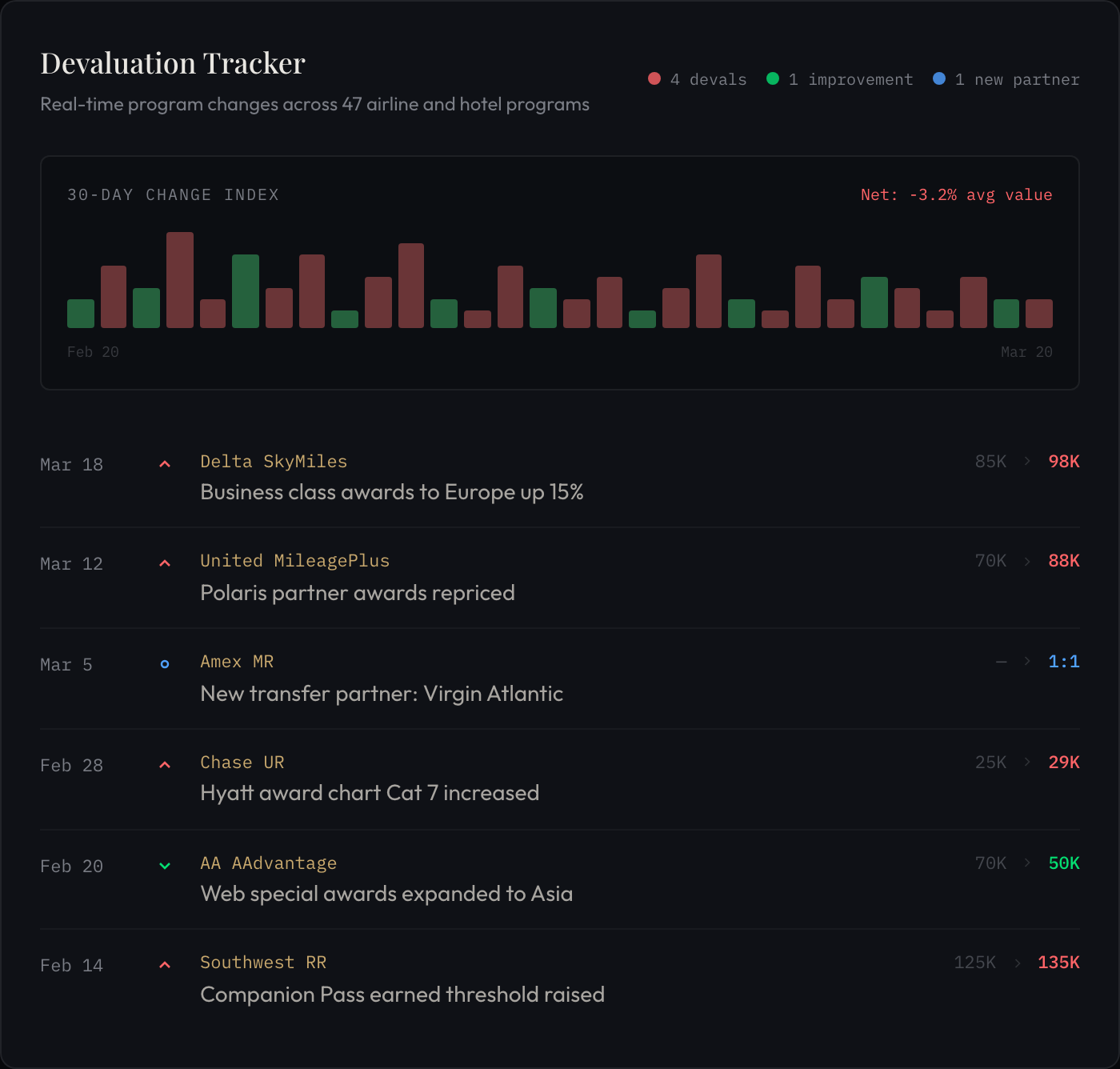
Hyatt has not published a comprehensive list of which specific properties changed categories in an easily searchable format. The most reliable way to check a specific hotel is to search award availability directly at hyatt.com and compare the point cost to what you remember (or what's documented in third-party analyses). You can also track historical category shifts and flag devaluations for properties on your watchlist using the MileIntel devaluation tracker.
Did my Hyatt points just lose value?
Yes, but the degree depends on how you redeem.
For aspirational travelers targeting Category 8 luxury properties during peak travel periods, this is a significant devaluation. A stay that cost 45,000 points per night can now cost 75,000. If you were saving 135,000 points for a 3-night stay, you may now need 225,000 points for the same trip at peak pricing. That's a 67% point requirement increase.
For flexible travelers who book Category 1-4 properties, the impact is considerably softer. The Lowest/Low tiers at these categories are often available for off-season travel.
One genuine silver lining: free night certificate caps increased.
- Category 1-4 certificate: now covers nights up to 25,000 points (was 18,000)
- Category 1-7 certificate: now covers nights up to 55,000 points (was 35,000)
In my experience, this matters most if you hold the World of Hyatt Credit Card or receive certificates through elite status. A certificate that used to top out at 18,000 points can now cover a Moderate-tier night at a formerly out-of-reach property. That's a real upgrade in certificate utility, even if the properties you can use them at got more expensive overall.
How does Hyatt's fixed chart compare to Marriott's and Hilton's dynamic pricing?
This is where Hyatt still wins, and the gap matters more than ever.
Despite the devaluation, Hyatt publishes a fixed award chart with defined point thresholds. You can look up a Category 6 hotel today and know that the maximum you'll ever pay for a standard room is 40,000 points (at the new "Top" tier). That ceiling is public and contractual.
Marriott Bonvoy and Hilton Honors both use fully dynamic pricing. There is no published award chart. A Marriott property that costs 50,000 points today can cost 70,000 points next month with no notice and no ceiling. Hilton properties can swing into six-figure point territory during high-demand periods.
See the full comparison below, but the short version: Hyatt's chart is a devaluation, not an abandonment of transparency. That distinction is meaningful if you're trying to plan a trip more than a few weeks out.
For a side-by-side breakdown of how Hyatt, Marriott, and Hilton handle award pricing, redemption floors, and transfer partner ratios, see our Hyatt vs. Marriott comparison.
Should I book before May 20, or is it too late?
If you're reading this after May 20, 2026, the old chart is gone. The window for locking in old pricing has closed.
What you should do now:
- Identify your target property's current tier pricing. Go to hyatt.com, search award availability for your dates, and note the point cost. Compare it to the Category chart to determine which tier you're looking at.
- Check if your property changed categories. If it moved up a category, your points cost more. If it moved down, you're getting a discount. Use the MileIntel devaluation tracker to see a running log of category shifts without manually cross-referencing the old chart.
- Book confirmed award space now if you find Lowest or Low tier pricing. Hyatt has explicitly stated that the Upper and Top tiers will see "broader adoption" in future years. Prices are likely to increase further, not decrease.
- Transfer Chase or Bilt points only after confirming award space. Both programs transfer to Hyatt at 1:1. Before initiating any transfer, verify current partner ratios and processing times using the MileIntel transfer partners tool — transfer timelines can affect whether award space holds.
Frequently Asked Questions
What changed in Hyatt's award chart in May 2026?
Hyatt replaced its 3-tier seasonal pricing model (Off-peak, Standard, Peak) with a 5-tier structure (Lowest, Low, Moderate, Upper, Top) across all 8 hotel categories. The category structure itself remained unchanged; only the number of pricing tiers within each category increased.
How much more expensive is Hyatt under the new award chart?
The maximum increase is 67% for Category 8 hotels at the Top tier (from 45,000 to 75,000 points), but analysis of 19 popular properties shows the average increase is only 10%. Most travelers will see modest increases, not the headline-grabbing maximum.
Which Hyatt properties became ineligible for free night certificates?
Fourteen U.S. properties moved out of the Category 1-4 range, making them ineligible for the popular free night certificates. In total, 112 hotels moved to higher categories, while 24 moved lower.
Did transfer rates from credit card programs change?
No. Transfer ratios from Chase Ultimate Rewards and Bilt Rewards to World of Hyatt remain 1:1, unchanged from before the award chart restructuring.
Sources
- How Hyatt's new award chart has changed prices at popular hotels — The Points Guy
- We Analyzed 368K Hyatt Award Nights... & The Findings Are Brutal — Thrifty Traveler
- Hyatt Just Made Free Nights Cost More — And Says Next Year Will Be Worse — View from the Wing
- I analyzed 1.1M Hyatt rates to figure out what the new award chart actually means — r/awardtravel
- My Hyatt post-pointpocolypse plans — Frequent Miler
Get articles like this in your inbox
The Mileage Run — one short email when something actually changes your travel math. No filler, no affiliate trash, no spam. Unsubscribe anytime.