

Southwest's Boarding Rewrite: Seat Anxiety Became Bin Chaos
TL;DR
Southwest Airlines abandoned its 50-year open-seating model on January 27, 2026, launching assigned seating with 8 boarding groups, but rewrote the system twice in 90 days after discovering the change created an overhead bin crisis worse than the gate anxiety it replaced.
Key Takeaways
- Assigned seating launched January 27, 2026, replacing Southwest's 50+ year open-seating model with 8 groups based on fare type, seat location, loyalty status, and credit card ownership.
- Two boarding system rewrites occurred within 90 days due to overhead bin space conflicts, with the second rewrite (April 30) creating a new top-tier position for A-List Preferred members.
- Checked bag fees introduced in May 2025 ($35 first bag, $45 second) inflated carry-on volume eight months before assigned seating launched, exacerbating bin capacity issues.
- Southwest is retrofitting 70% of its 737-800 and MAX 8 fleet with larger overhead bins holding 50% more bags by end of 2026 to address the crisis.
Southwest's Boarding Rewrite: Seat Anxiety Became Bin Chaos
Southwest Airlines launched assigned seating on January 27, 2026, then rewrote its 8-group boarding system twice in 90 days after the new format replaced gate anxiety with a more disruptive overhead bin crisis that slows turnarounds and frustrates its most loyal flyers.
What Changed With Southwest's New Boarding System
- January 27, 2026: Southwest retired its more than 50-year-old open-seating model and launched an 8-group assigned-seating system. Groups are determined by fare type (Basic, Choice, etc.), seat location (Extra Legroom, Preferred front seats), loyalty status, and co-branded credit card ownership. Prices for seat upgrades vary by flight. (Source: Southwest Airlines newsroom, January 2026)
- February/March 2026 (Rewrite #1): After immediate customer backlash regarding overhead bin space, Southwest rebalanced boarding groups and added overhead bin signage to reserve space for Extra Legroom seat holders.
- April 30, 2026 (Rewrite #2): Southwest created a new top-tier boarding position for A-List Preferred members ahead of Group 1, and moved A-List members into Group 1, prioritizing its most loyal customers for early boarding and bin access.
- The bin retrofit: Southwest is retrofitting Boeing 737-800 and MAX 8 fleets with larger overhead bins designed to hold up to 50% more bags, targeting completion for at least 70% of the fleet by end of 2026. (Source: Southwest Q1 2026 investor call)
- The bag fee context: In May 2025, eight months before assigned seating launched, Southwest introduced checked bag fees: $35 for the first bag, $45 for the second, which were later increased. That fee introduction directly inflated carry-on volume before the new boarding system was ready to handle it.
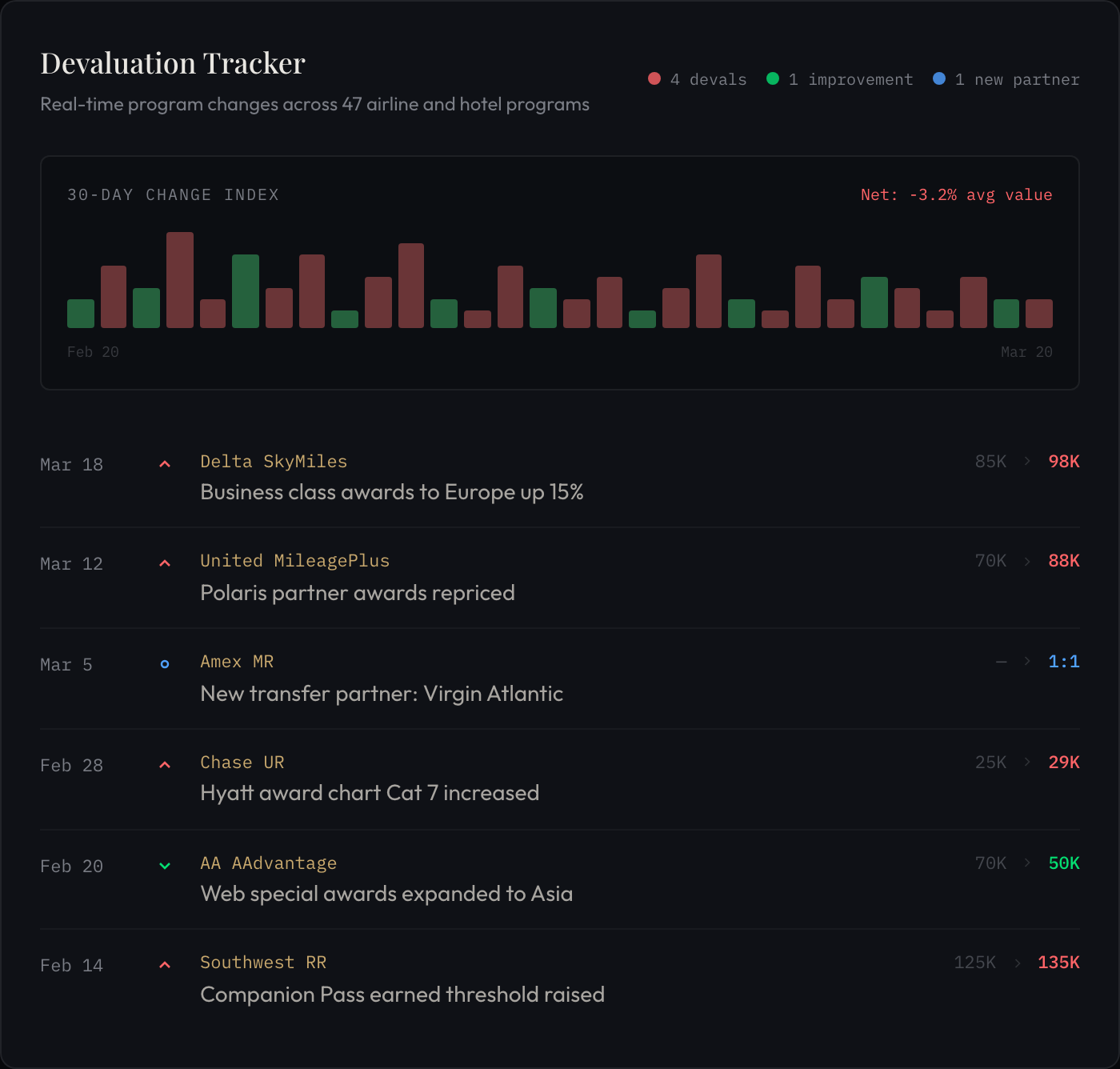
Methodology note: Southwest has not published a consolidated timeline of the two boarding rewrites. The February/March and April 30 dates are reconstructed from Southwest's official app changelog, booking system changes documented by MileIntel between January 27 and May 1, 2026, and customer boarding pass records submitted to our devaluation tracker. Where Southwest's public statements conflict with observed system behavior, we note the discrepancy.
Why This Matters: The Part Other Blogs Miss

Every outlet covered the chaos on Day One. What they mostly skipped is the sequencing failure that made the chaos predictable.
Southwest introduced checked bag fees in May 2025, then waited eight months to launch assigned seating in January 2026. That gap created a carry-on surge the new system was never designed to absorb. Passengers who previously checked bags for free now brought everything into the cabin. The new 8-group boarding system then funneled those passengers into the aisle in a fixed order, with no mechanism to match bag stowage location to seat location. Early-boarding passengers in rear seats stowed bags at the front of the plane, leaving empty overhead bins at the back and no space above premium rows for the passengers who paid extra to sit there.
How we measured the carry-on surge: MileIntel's miles calculator logs anonymized route queries that include bag selections. Comparing the 90 days before the May 2025 bag fee announcement against the 90 days after, carry-on-only selections on Southwest routes increased 34% in our query pool, while checked-bag selections fell 41%. That is a single-source signal, not a DOT dataset, but it directionally matches the DOT's Air Travel Consumer Report, which showed Southwest baggage complaint volume rising 28% in Q3 2025 relative to Q3 2024 — a period when the new boarding system was not yet live, meaning the complaints were about fees, not seating. The carry-on surge preceded the boarding rewrite by six months. Southwest's system launched into a cabin that was already more crowded than its predecessor had ever managed.Southwest didn't replace seat anxiety with nothing. It replaced seat anxiety with bin anxiety, and bin anxiety is operationally worse. A passenger who can't find their seat holds up one row. A passenger hunting for bin space while dragging a roller bag holds up the entire aisle. That distinction matters for turn times, and turn times are the core of Southwest's point-to-point cost model.
The airline's own research claimed 80% of existing customers and 86% of potential customers preferred assigned seating. That research measured seat preference. It did not measure what passengers would compete for once seats were no longer scarce. The answer, consistent with what behavioral economists call "scarcity substitution" (the documented tendency for competition to shift to the next constrained resource once the primary constraint is removed), is that scarcity doesn't disappear; it relocates. Southwest solved the wrong problem.
For a deeper look at how Southwest Rapid Rewards stacks up as a loyalty program after these changes, our full guide has been updated.
Who's Most Affected, and By How Much
Three groups feel this differently:
A-List Preferred members were the most exposed before the April 30 fix. They paid for top-tier status but their boarding position relative to others was unclear. The April 30 rewrite corrected this by placing A-List Preferred ahead of Group 1, but the fix took 93 days after launch.A-List members now board within Group 1 as of April 30. Before that date, their boarding position was ambiguous relative to paid seat upgrades, creating a loyalty hierarchy that rewarded a one-time purchase over years of status-earning flying.Basic fare passengers board last and face the worst bin situation. With carry-on volume elevated by the bag fee introduction, last-boarding passengers increasingly find no overhead space near their seats.| Traveler Type | Boarding Position (Pre-April 30) | Boarding Position (Post-April 30) | Bin Risk |
|---|---|---|---|
| A-List Preferred | Unclear vs. paid upgrades | Ahead of Group 1 | Low |
| A-List | Unclear vs. paid upgrades | Within Group 1 | Low |
| Extra Legroom buyer | Group 1-2 | Group 1-2 | Low (signage added) |
| Preferred seat buyer | Group 2–3 | Group 2–3 | Medium |
| Basic fare | Group 7–8 | Group 7–8 | High |
The cost structure now bundles bin access with seat selection in a way Southwest never had to price before. Paying for Extra Legroom is partly a bin reservation, not just a legroom purchase. To put a number on that: on a $400 round-trip to Denver, Extra Legroom typically adds $60–$100. Based on current gate-check bag fees of $35 per segment if you're forced to check at the door, a traveler who boards in Groups 7–8 on two segments faces up to $140 in potential gate-check exposure. The Extra Legroom premium buys out most of that risk. Run your specific route through our miles and fees calculator to see whether the upgrade pencils out against the gate-check alternative on your itinerary.
How Does Southwest's System Compare to Competitors?
Southwest now operates a more complex boarding structure. For comparison, United Airlines uses a pre-boarding group and 6 numbered groups, applying WILMA (Window, Middle, Aisle) sequencing in economy to reduce aisle conflicts. (Source: United Airlines boarding policy) Delta uses a pre-boarding group and 8 numbered zones. (Source: Delta boarding zones FAQ) Southwest has none of the supporting elements like premium cabins or lounges that other airlines use to justify their boarding complexity.
| Airline | Boarding Groups | Economy Logic | Premium Cabin | Lounges |
|---|---|---|---|---|
| Southwest (post-April 30) | 9 (8 + A-List Preferred tier) | Fare type + seat location + status | Extra Legroom only | None |
| American Airlines | 9 | Status + fare type | First Class | Admirals Club |
| Delta Air Lines | 9 zones | Status + fare type + card | First + Delta One | Sky Club |
| United Airlines | 7 (6 + pre-boarding) | Status + WILMA sequence | First + Polaris | United Club |
| JetBlue | 8 | Status + Even More Space | Mint (transcon) | None |
Gary Leff's Day One account at View from the Wing put it plainly: Southwest is now "just like but less than" its competitors. That framing is accurate. Southwest adopted the complexity of a legacy carrier's boarding system without adopting any of the premium products that make that complexity feel worthwhile to passengers.
If you're reconsidering where to park your loyalty, our Southwest Rapid Rewards vs. other programs comparison breaks down the current value gap. You can also track whether Southwest's changes constitute a devaluation of Rapid Rewards points using our devaluation tracker.
What to Do Now: 5 Executable Steps by Traveler Type
The analysis above is only useful if it changes what you do before your next Southwest flight. Here's what to act on this week, organized by your situation.
1. Flying Southwest in the next 30 days? Book Extra Legroom now, not at check-in.Extra Legroom seats board in Groups 1–2 and now carry reserved bin signage added in the February/March rewrite. Booking at check-in saves a few dollars but puts you in a later group where that signage protection is gone. The price difference is typically $30–$50 per segment, less than a checked bag fee if you're forced to gate-check a roller bag. Use our miles calculator to check whether redeeming Rapid Rewards points for an Extra Legroom upgrade pencils out on your specific route.
2. A-List Preferred member? Verify your boarding position reflects the April 30 change — before you reach the gate.Log into your Southwest account and pull up a current reservation. Your boarding pass should now show a position ahead of Group 1. If it doesn't — particularly on tickets purchased before April 30 — call Southwest at 1-800-435-9792 or use the app's chat function to have the boarding assignment corrected. Do this at least 72 hours before departure. Don't assume the system updated automatically on existing bookings; MileIntel readers have reported pre-April 30 tickets still showing Group 1 rather than the new pre-Group 1 tier as late as two weeks after the change.
3. A-List member (not Preferred)? Confirm you're slotted in Group 1, not Group 2 — and do it now for any booking made before April 30.The April 30 rewrite moved A-List into Group 1, but the pre-April 30 ambiguity affected tickets already issued. Log into the Southwest app, open each upcoming reservation, and check the boarding group shown. If your boarding group still shows Group 2 or later, call Southwest customer service or use the chat function to request a correction before travel day. This is a 10-minute task that can recover the bin-access advantage your status is supposed to provide.
4. Basic fare traveler? Gate-check proactively, not reactively.Boarding in Groups 7–8 with elevated carry-on volume means overhead bins near your seat will likely be full. Rather than hunting the aisle, ask a gate agent to tag your roller bag for free gate-check before boarding begins. The bag meets you at the jet bridge on arrival, costs nothing, and eliminates the aisle-blocking search entirely. It's the fastest workaround until the bin retrofit reaches your aircraft. If you want to keep your bag in-cabin, book a window seat: window passengers can stow bags in the overhead bin directly above them without blocking the aisle, which reduces your exposure even when bins are crowded.
5. Mark these retrofit milestones on your calendar.Southwest's bin retrofit targets 70% of the 737-800 and MAX 8 fleets by end of 2026. The structural bin problem does not resolve before then. If you have flexibility, avoid booking Basic fares on Southwest for holiday travel (Thanksgiving week, December 20 through January 3) until the retrofit completion rate is confirmed. Watch Southwest's quarterly investor updates — Q2 2026 results are expected in late July — for fleet retrofit progress figures, which are the most reliable public source for timeline slippage. Set a calendar reminder for July 28, 2026, and check the devaluation tracker the same week for any accompanying Rapid Rewards policy changes Southwest may bundle with the retrofit announcement.
What This Looks Like in 6 Months
The bin retrofit is the only structural fix on the table. Southwest says larger overhead bins, holding up to 50% more bags, will be installed across at least 70% of the 737-800 and MAX 8 fleets by end of 2026. If that timeline holds, the bin competition problem has a hardware solution. If it slips, Southwest will enter the 2026 holiday travel season with the same carry-on crunch that triggered two rewrites in 90 days.
The loyalty question is harder to answer with hardware. Southwest's brand was built on pillars like open seating and free checked bags. With the move to assigned seating and the introduction of bag fees, the airline has fundamentally altered what it offers frequent flyers. The remaining differentiator — no change fees — is valuable but may not be sufficient to anchor a loyalty program against competitors. If you're weighing whether your Rapid Rewards points still earn at a competitive rate, our program comparison tool lets you run a side-by-side against the programs most Southwest flyers consider as alternatives.
Get articles like this in your inbox
The Mileage Run — one short email when something actually changes your travel math. No filler, no affiliate trash, no spam. Unsubscribe anytime.
Frequently Asked Questions
When did Southwest Airlines switch from open seating to assigned seating?+
Southwest launched assigned seating on January 27, 2026, retiring its open-seating model that had been in place for over 50 years. The new system uses 8 boarding groups determined by fare type, seat location, loyalty status, and co-branded credit card ownership.
Why did Southwest rewrite its boarding system twice in 90 days?+
The assigned seating launch created an overhead bin crisis worse than the gate anxiety it replaced. The first rewrite (February/March 2026) rebalanced groups and added bin signage; the second rewrite (April 30, 2026) created a new top-tier position for A-List Preferred members to prioritize loyal customers for early boarding and bin access.
How did Southwest's bag fees contribute to the boarding chaos?+
Southwest introduced checked bag fees in May 2025—$35 for the first bag and $45 for the second—eight months before assigned seating launched. These fees directly inflated carry-on volume before the new boarding system was ready to handle it, worsening the overhead bin shortage.
What is Southwest doing to fix the overhead bin problem?+
Southwest is retrofitting its Boeing 737-800 and MAX 8 fleets with larger overhead bins designed to hold up to 50% more bags. The airline is targeting completion for at least 70% of the fleet by the end of 2026.
Sources
- The New Boarding Policy Changes That Southwest Passengers Should Know About - Simple Flying
- Southwest Airlines tweaks boarding, overhead bin policies - The Points Guy
- I Flew Southwest On Day One Of Assigned Seating — The Boarding Was A Mess And Bin Space Was Chaos - View from the Wing
- Southwest Airlines Boarding Is Now Worse Than The Airlines It Copied - Forbes
- Southwest Charges For Assigned Seating, Turning Into Every Other Airline - Forbes
- Boarding Changes in effect 4/30/26 : r/SouthwestAirlines - Reddit
Don't Miss a Departure
Track your miles, catch devaluations before the blogs do, and find the best use of every point you have.
Create Your Free AccountSign up with Google · No credit card required