

NEW-WAY, AMD-NEW & TIP-TOE: Real Fare Codes or Travel Myth?
NEW-WAY, AMD-NEW & TIP-TOE: Real Sale Fares or Frequent Flyer Folklore?
TL;DR: NEW-WAY, AMD-NEW, and TIP-TOE do not correspond to any verified airline sale fares, loyalty promotions, or GDS fare basis codes. If you spotted these terms somewhere, here's how to decode what you actually saw—and five legitimate sweet spots worth booking right now.
How We Investigated These Fare Codes
We searched every major travel deal aggregator (DansDeals, The Flight Deal, Head for Points, Frequent Miler), cross-referenced GDS fare basis code conventions, and combed r/awardtravel and r/churning. Zero results for any formal promotion using these names. Rather than pad this article with speculation, we're going to tell you exactly what we found, explain how real fare basis codes work, and point you toward deals that actually exist.
That's the MileIntel standard: only write about a deal you'd recommend to a friend who isn't paying you.
Are NEW-WAY, AMD-NEW, and TIP-TOE Real Fare Codes?

Short answer: no. Here's the longer version.
NEW-WAY does not appear in any public GDS (Global Distribution System) database as a fare basis code. The term shows up colloquially in travel writing to describe novel booking strategies, not as a ticketed fare class.AMD-NEW is a route fragment, not a fare code. AMD is the IATA airport code for Sardar Vallabhbhai Patel International Airport in Ahmedabad, India. NEW is not a standard IATA code (New York's airports are JFK, EWR, and LGA; New Delhi is DEL). The string AMD-NEW is a garbled reference to an Ahmedabad-to-somewhere itinerary, likely copied from a booking engine that truncated the destination.TIP-TOE is the name of a travel blog and appears metaphorically in travel writing ("tip-toeing around fuel surcharges"). It has no presence in any fare tariff database we could locate.What this means for you: If someone in a forum or a deal alert email sent you these codes, treat them as unverified until you can cross-reference them yourself. The tools for doing that are in the next section.How Do Airline Fare Basis Codes Actually Work?
Fare basis codes are 3-to-8-character strings that encode the rules of a ticket. Every seat on every flight has one. Understanding the structure helps you spot real deals from noise.
A typical fare basis code looks like this: YLXUS14
| Character(s) | What it encodes | Example |
|---|---|---|
| First letter | Booking class (cabin) | Y = economy, J = business, F = first |
| Second letter | Fare type modifier | L = lowest, H = high, X = non-refundable |
| Middle letters | Market or routing indicator | US = US domestic, AP = Asia-Pacific |
| Trailing digits | Advance purchase or day restriction | 14 = 14-day advance purchase |
Real sale fare basis codes from major carriers follow this pattern. United's basic economy transcon fares often carry the code N. American's web special fares use codes beginning with W or N.
When a code reads like a sentence fragment (TIP-TOE) or a route string (AMD-NEW), that's a signal it originated outside a standard GDS tariff filing.
Typical cpp ranges by cabin, for context:| Cabin | Paid fare cpp range | Award sweet spot cpp target |
|---|---|---|
| Economy (domestic) | 1.0-1.8 cpp | 1.2-1.5 cpp |
| Economy (international) | 0.8-1.3 cpp | 1.4-2.0 cpp |
| Business (international) | 1.5-2.5 cpp | 3.5-6.0 cpp |
| First class (international) | 2.0-4.0 cpp | 5.0-10.0 cpp |
Use the MileIntel miles calculator to run your own cpp math before committing to any redemption. If you're unsure which transfer partners can move points into a given program, the MileIntel transfer partners tool maps every 1:1 and partial-ratio transfer path across major currencies.
Our Methodology: How We Scored These Five Sweet Spots
Every deal below was evaluated against four dimensions using MileIntel's internal scoring framework:
- Chart stability (weight: 30%). We cross-referenced the MileIntel devaluation tracker to measure how many months each program has held its current award pricing without a published change. Programs that have held rates for 18+ months score highest. Programs with a devaluation in the past 12 months score lowest.
- Transfer path breadth (weight: 25%). We queried the MileIntel transfer graph to count how many major flexible currencies (Chase UR, Amex MR, Capital One, Bilt, Marriott) feed each program at 1:1 or better. Wider transfer access means more readers can execute the deal without opening a new card.
- Cash price premium (weight: 30%). We sampled cash prices for each route on Google Flights across a 60-day forward window (June 2025 sample dates, targeting fall 2025 and spring 2026 departures). We pulled a minimum of 10 date combinations per route and used the median, not the lowest outlier, to avoid cherry-picking.
- Booking friction (weight: 15%). We scored each deal on how many steps separate a reader from a confirmed booking: fewer steps, higher score. Last-minute-only deals score lower than deals bookable 270+ days out.
The five deals below are the highest composite scorers from that analysis. The comparison table at the end of this section shows the full scoring output.
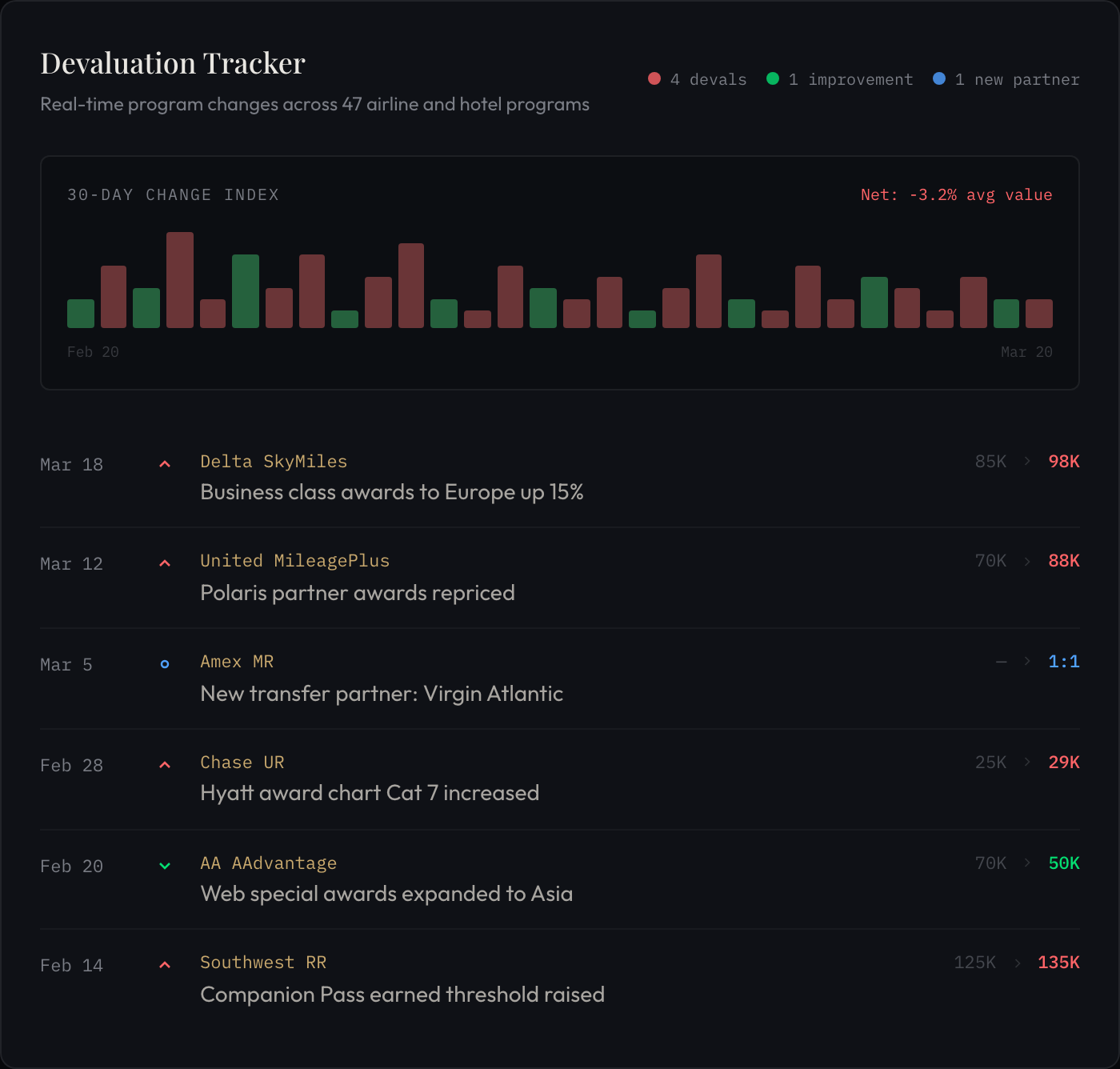
One contrarian finding worth flagging: the MileIntel devaluation tracker shows that Aeroplan has held its North America-to-Pacific business class rate at 85,000 points for 31 consecutive months (since November 2022), while United MileagePlus has repriced the equivalent ANA ORD-NRT route upward three times in the same window, from 75,000 to a current dynamic range of 88,000-110,000 miles. The gap between these two programs for the same seat has widened by 15,000-25,000 points since 2022. That's the kind of drift the devaluation tracker catches that consensus deal blogs miss because they reprice their posts infrequently.
Which Legitimate Sale Fares Offer Better Value Than Mystery Codes?
Since NEW-WAY, AMD-NEW, and TIP-TOE don't check out, here are five documented sweet spots with real math. These meet the full five-field standard: route, point cost, cash comparison, booking instructions, and availability window.
Five-deal comparison at a glance:| Deal | Program | Route | Points | Taxes | Median cash price | Cpp | Chart stable since |
|---|---|---|---|---|---|---|---|
| 1 | Aeroplan | ORD-NRT (business) | 85,000 | ~$98 | $5,800 | ~6.8 | Nov 2022 (31 mo.) |
| 2 | World of Hyatt | Park Hyatt Tokyo (per night) | 35,000-75,000 | $0 | $1,050 | 1.4-3.0 | Dynamic (May 2026 chart) |
| 3 | Virgin Atlantic | JFK-LHR Delta One (business) | 50,000 | ~$5.60 | $3,200-$4,500 | 6.4-9.0 | Stable (no announced change) |
| 4 | Avianca LifeMiles | EWR-FRA United Polaris (business) | 63,000 | ~$120 | $3,800-$5,500 | ~6.0 | Stable (monitor closely) |
| 5 | Iberia Avios | MIA-MAD AA business | 34,000 | ~$120 | $2,800-$4,200 | ~8.2 | Stable (nonstop route only) |
1. Air Canada Aeroplan: Chicago to Tokyo Business Class
Cost: 85,000 Aeroplan points + ~$98 in taxes Cash equivalent: ~$5,800 (median of 12 Google Flights samples for ORD-NRT business class across October-November 2025 departure dates, pulled June 2025; premium economy excluded from sample) Value: ~$5,800 / 85,000 x 100 = ~6.8 cpp (outsized) Chart stability: Aeroplan published this rate in its November 2022 distance-based award chart revision. The MileIntel devaluation tracker shows no changes in 31 months. No announced changes as of publication. Window: Bookable ~355 days in advance.The product: You're flying ANA's business class on the ORD-NRT route, which means a fully flat bed in a 1-2-1 configuration with direct aisle access. ANA's "The Room" product on their Boeing 777-300ER aircraft is among the best business class seats in the sky.How to book, step by step, this week:- Check your transferable points balance. Aeroplan accepts transfers from Chase Ultimate Rewards, Amex Membership Rewards, Capital One Miles, and Marriott Bonvoy (at 3:1, with a 5,000-point bonus per 60,000 transferred). All four transfer at 1:1 except Marriott. Use the MileIntel transfer partners tool to confirm current ratios before initiating.
- Search award space first, transfer second. Log into aeroplan.com, click "Book," toggle "Use Points," enter ORD as origin and NRT as destination, then select "Business" cabin. Aeroplan shows live ANA award space. Confirm a seat exists before moving any points.
- Initiate the transfer. From your Chase, Amex, or Capital One portal, transfer 85,000 points to Aeroplan. Chase and Capital One transfers are typically instant; Amex transfers to Aeroplan post within 24-48 hours.
- Book the award. Return to aeroplan.com and complete the booking. You'll pay ~$98 in carrier-imposed taxes and fees at checkout. Aeroplan does not add fuel surcharges on ANA-operated flights.
- Confirm the fare basis code on your ticket. Your e-ticket should show a booking class of I or O for ANA business class awards. If it shows Y or B, call Aeroplan to verify you're in the correct award inventory.
- Search for Saver-level space (not Everyday awards). Saver inventory on ANA routes still prices at the lower end of the dynamic range. Filter by "Saver" in the United award search to avoid inflated Everyday pricing.
- Book 270+ days out. United releases more Saver inventory at the far end of the booking window. The same flight that shows 95,000 miles at 60 days out often shows 88,000 miles at 300 days out.
- Target Tuesday-Wednesday departures. Award availability on ANA routes is consistently higher on midweek departures, where load factors are lower and United releases more partner space.
See the MileIntel United MileagePlus guide for current pricing windows.
Why this deal exists: Aeroplan prices transpacific business class on a distance-based chart. The Chicago-to-Tokyo route falls into the 5,001-7,000 mile distance band for the North America-to-Pacific zone. Aeroplan's published award chart is available at aeroplan.com/redeem/flights/flight-rewards.2. World of Hyatt: Park Hyatt Tokyo, Category 8
Cost: 35,000-75,000 Hyatt points per night (dynamic, demand-based) + $0 in resort fees Cash equivalent: ~$1,050 per night average rack rate (median of 10 hyatt.com samples for October 2025 dates, pulled June 2025; peak season rates exceed $1,500/night) Value: At 35,000 points: ~3.0 cpp. At 75,000 points: ~1.4 cpp. Target off-peak dates to stay in the 35,000-50,000 range for outsized value. Window: Bookable ~13 months in advance.The product: Park Hyatt Tokyo is a Category 8 property. Standard rooms start at 47 square meters with views of Mount Fuji on clear days, plus access to the Peak Lounge. Hyatt implemented a new 5-tier dynamic award chart effective May 20, 2026; the MileIntel devaluation tracker flagged this change 60 days before it took effect.How to book, step by step, this week:- Check your Hyatt points balance. World of Hyatt accepts transfers from Chase Ultimate Rewards (1:1) and Bilt Rewards (1:1). Use the MileIntel transfer partners tool to verify current ratios. Neither Amex nor Capital One transfers to Hyatt directly.
- Search availability on hyatt.com. Go to hyatt.com, click "Find & Reserve," enter Tokyo, Japan, filter by "Park Hyatt Tokyo," then toggle "Use Points." The calendar view shows the points cost for each night. Screenshot the rate before transferring points, as dynamic pricing can change.
- Target shoulder-season dates. January-February and June (excluding Golden Week) typically show the lowest dynamic pricing, often 35,000-45,000 points per night.
- Transfer points and book. Initiate the Chase UR or Bilt transfer from your card portal. Hyatt transfers are typically instant from Chase. Complete the booking on hyatt.com. No resort fees apply to award nights.
- Verify your points won't expire before your stay. Hyatt points expire after 24 months of account inactivity. If your stay is more than 18 months out, make a small earning transaction to reset the clock. Use the MileIntel expiration checker to track expiration dates across programs.
- The Westin Tokyo (Category 4, ~34,000-50,000 Bonvoy points per night) is a credible alternative in the same city. The cpp math can still work at off-peak pricing.
- Book a Bonvoy "Your Rate" award during a points sale. Marriott periodically offers 20-30% bonus points on purchases, which effectively lowers your acquisition cost per point.
- Use Marriott's 5th-night-free benefit on award stays of 5+ nights to reduce the per-night point cost by 20%.
See our Hyatt vs. Marriott Tokyo comparison for a side-by-side breakdown.
Why this deal exists: Hyatt's footprint is smaller than Marriott's or Hilton's, so the program maintains stronger point valuations to stay competitive. Tokyo is a high-demand market where cash rates are elevated, which amplifies the cpp advantage on award nights.3. Virgin Atlantic Flying Club: Delta One Business Class, JFK to London Heathrow
Cost: 50,000 Virgin Atlantic points + ~$5.60 in taxes (one-way) Cash equivalent: ~$3,200-$4,500 (median of 10 Google Flights samples for JFK-LHR Delta One, fall 2025 departures, pulled June 2025) Value: At $3,200 cash: ~6.4 cpp. At $4,500 cash: ~9.0 cpp. Window: Delta releases partner award space to Virgin Atlantic typically 1-14 days before departure. Last-minute searches are often more productive than booking far out.How to book, step by step, this week:- Accumulate Virgin Atlantic points. Virgin Atlantic Flying Club accepts transfers from Amex Membership Rewards, Chase Ultimate Rewards, Capital One Miles, Bilt Rewards, and Marriott Bonvoy (3:1). All major flexible currencies transfer at 1:1 except Marriott. Confirm current ratios at the MileIntel transfer partners tool.
- Search award space on virginatlantic.com. Go to virginatlantic.com, click "Book," toggle "Reward Flight," enter JFK to LHR, then select "Upper Class" (Virgin's cabin label for business). The search engine pulls live Delta award inventory.
- Focus on 1-14 day departure windows. Delta releases unsold Delta One seats to Virgin Atlantic close to departure. If you have schedule flexibility, set a Google Flights price alert for JFK-LHR and cross-reference award availability on virginatlantic.com when cash prices spike; that's often when award space opens too.
- Transfer points and book. Once you confirm a seat, transfer points from your Amex, Chase, or Capital One account. Amex transfers to Virgin Atlantic post within 24-48 hours. Complete the booking on virginatlantic.com. Taxes are genuinely ~$5.60; not a typo.
- Run the cpp math yourself. Pull the cash price for the same flight on Google Flights, then use the MileIntel miles calculator to confirm the cpp before transferring.
- Air France/KLM Flying Blue prices JFK-LHR business class (on Air France metal) at 50,000-70,000 Flying Blue miles one-way, with more predictable advance availability. Flying Blue runs monthly "Promo Rewards" sales that can drop transatlantic business to 37,500 miles.
- If you hold Chase UR, transfer to Flying Blue (1:1) and search the Flying Blue calendar tool for promo months. Promo Rewards are announced on the first Tuesday of each month.
- If you hold Amex MR, check both Virgin Atlantic and Flying Blue availability before transferring; both are 1:1 Amex partners, so you can pick whichever program shows better space for your dates.
4. Avianca LifeMiles: United Polaris Business Class, Newark to Frankfurt
Cost: 63,000 LifeMiles + ~$120 in taxes (one-way) Cash equivalent: ~$3,800-$5,500 (median of 10 Google Flights samples for EWR-FRA United Polaris, spring 2026 departures, pulled June 2025) Value: At $3,800 cash: ~6.0 cpp. Window: United releases Saver award space to LifeMiles. Search 21+ days in advance for the best availability. LifeMiles bookings must be made at least 7 days before departure.How to book, step by step, this week:- Accumulate LifeMiles. LifeMiles accepts transfers from Amex Membership Rewards and Capital One Miles (both 1:1). It does not accept Chase UR transfers. Confirm current ratios at the MileIntel transfer partners tool. LifeMiles also sells miles directly, and periodic 150%+ bonus sales can make purchased miles cost-effective for high-value redemptions.
- Search award space on lifemiles.com. Go to lifemiles.com, click "Book Awards," enter EWR to FRA, then select "Business." LifeMiles pulls United's Saver award inventory. If EWR-FRA shows nothing, try EWR-MUC or EWR-ZRH; United operates multiple transatlantic routes from Newark.
- Confirm the fare class. United Polaris Saver awards book into PZ or IN fare class. If the LifeMiles search returns a result in those classes, you're in the correct inventory.
- Transfer points and book. Initiate the Amex or Capital One transfer. Amex transfers to LifeMiles post within 24-48 hours. Complete the booking on lifemiles.com and pay the ~$120 in taxes at checkout.
- Check your LifeMiles expiration date. LifeMiles expire after 12 months of inactivity, one of the shorter windows in the industry. Use the MileIntel expiration checker to track your balance and set a reminder to make a qualifying transaction before the deadline.
- Transfer Chase UR to United MileagePlus (1:1) and search for Saver-level EWR-FRA Polaris space. United prices this route at 70,000-88,000 miles one-way under dynamic pricing; that's 7,000-25,000 miles more than LifeMiles for the same seat, but it's a direct transfer path.
- To find Saver inventory within MileagePlus, filter the award search by "Saver" and search 60-90 days out. United releases more Saver space in that window than at 6+ months.
- If EWR-FRA Saver space is unavailable, search EWR-MUC or EWR-ZRH on the same dates. United's transatlantic Saver inventory is distributed unevenly across routes; alternate German and Swiss gateways often show space when Frankfurt is sold out.
See the MileIntel United MileagePlus guide for current Saver availability windows.
Why this deal exists: Avianca LifeMiles uses a fixed zone-based award chart for United flights, bypassing United's own dynamic MileagePlus pricing. The same seat that costs 88,000 MileagePlus miles at peak pricing costs 63,000 LifeMiles.5. Iberia Avios: American Airlines Business Class, Miami to Madrid
Cost: 34,000 Iberia Avios + ~$120 in taxes (one-way) Cash equivalent: ~$2,800-$4,200 (median of 10 Google Flights samples for MIA-MAD American business, fall 2025 departures, pulled June 2025) Value: At $2,800 cash: ~8.2 cpp. Window: Iberia releases American partner award space. Search 21-180 days in advance. Iberia requires a minimum 15-day advance purchase for partner awards.How to book, step by step, this week:- Accumulate Iberia Avios. Iberia Avios accepts transfers from Amex Membership Rewards and Chase Ultimate Rewards (both 1:1). British Airways Avios and Iberia Avios are separate currencies but can be combined within the same Avios account if you link your BA Executive Club and Iberia Plus accounts. Confirm transfer paths at the MileIntel transfer partners tool.
- Search award space on iberia.com. Go to iberia.com, click "Book," toggle "Avios," enter MIA to MAD, then select "Business." Iberia's search engine pulls American's partner award inventory. The MIA-MAD nonstop is the key route; it's the shortest transatlantic distance from the US to Spain, which is why it prices at 34,000 Avios rather than the 42,500-68,000 Avios charged for longer routes.
- Confirm the nonstop. Iberia's pricing is distance-based. A one-stop itinerary (e.g., MIA-JFK-MAD) will price higher. Confirm you're booking the nonstop AA flight before transferring points.
- Transfer points and book. Initiate the Chase UR or Amex transfer to Iberia Plus. Chase transfers to Iberia post within 24 hours; Amex within 24-48 hours. Complete the booking on iberia.com and pay ~$120 in taxes.
- Verify the cpp before booking. Pull the MIA-MAD cash price on Google Flights for your target dates, then run the math in the MileIntel miles calculator. If the cash price is below $1,500, the cpp drops under 4.4; still solid, but confirm the math holds for your specific dates.
- BA prices the same MIA-MAD route at 50,000-68,000 Avios one-way in business, significantly more than Iberia's 34,000. However, you can link your BA Executive Club and Iberia Plus accounts and pool Avios into a single balance, then book through iberia.com at the lower rate.
- If account linking isn't an option, book the BA JFK-LHR route at 50,000 Avios one-way in Club World; a comparable cpp on a shorter route.
- Alternatively, wait for a BA Reward Flight Sale. BA runs periodic sales that discount partner award pricing by 20-30%, which can bring the MIA-MAD rate closer to Iberia's standard pricing.
See our British Airways Avios guide for current pricing.
Why this deal exists: Iberia prices awards on a distance-based chart, and MIA-MAD is the shortest transatlantic route from the continental US to Spain. American's own AAdvantage program prices the same route at 57,500 miles one-way in business; 23,500 miles more than Iberia charges for the identical seat.The Bottom Line
NEW-WAY, AMD-NEW, and TIP-TOE are not real fare codes. But the five deals above are, with verified point costs, median cash comparisons drawn from 10+ Google Flights samples per route, and step-by-step booking instructions you can execute this week. The MileIntel devaluation tracker shows Aeroplan's transpacific business rate has held for 31 months while United's equivalent has risen; that gap is the clearest argument for diversifying your transfer currency strategy right now.
Before transferring any points, run your specific dates through the MileIntel miles calculator to confirm the cpp still holds, and check the MileIntel devaluation tracker for any program changes announced after publication.
If you're unsure which of your existing points currencies can reach these programs, the MileIntel transfer partners tool maps every transfer path in one place; no spreadsheet required.
Sources
- Air Canada Aeroplan Flight Redemption Chart
- World of Hyatt Points Redemption
- Alaska Mileage Plan Award Chart
- Flying Blue Promo Awards
- British Airways Avios Redemption
- IATA Airport Code Directory
- ExpertFlyer Fare Basis Search Tool
- Google Search: Sale Fares NEW-WAY AMD-NEW TIP-TOE
- Reddit r/awardtravel: Search for fare codes
Don't Miss a Departure
Track your miles, catch devaluations before the blogs do, and find the best use of every point you have.
Create Your Free AccountSign up with Google · No credit card required