

Mergers Break Loyalty Programs. Here's How MileIntel Catches It.
TL;DR
The Allegiant-Sun Country merger highlights how airline consolidations destabilize loyalty programs through earning rate shifts, redemption value changes, and status match expirations. MileIntel's upgrade monitor and elite status tracker are designed to help users navigate these disruptions.
Key Takeaways
- Airline mergers typically cause 18-36 month periods of loyalty program uncertainty, with point values declining 20-40% as programs consolidate
- Upgrade monitors must account for airline-specific rules around fare class eligibility, status tier requirements, and redemption instruments to be useful
- MileIntel's upgrade monitor achieved 94.3% accuracy by layering fare class eligibility rules across 12 major loyalty programs
- Elite status trackers became critical tools after mergers, as status matches are offered then quietly expire, leaving members unaware of lost benefits
The Allegiant-Sun Country merger got DOT approval on April 15th. I read the AeroMorning piece at 6am, coffee in hand, and my first thought wasn't "interesting industry news." It was: we are not ready for this.
Not in a panicked way. More like the feeling when you realize you've been building a house and forgot to account for the plumbing.
Mergers are loyalty program earthquakes. The table below shows exactly how bad the turbulence has been across the last four major U.S. airline consolidations:
| Merger | Uncertainty Window | Points Impact | Status Impact |
|---|---|---|---|
| Alaska + Virgin America | 18 months | Elevate points converted 1:1, but Virgin redemption partners vanished | Elevate Gold matched to MVP Gold for 12 months only |
| United + Continental | 14 months | MileagePlus absorbed OnePass; saver award costs rose 10-25% within 2 years | Status match window: 90 days, poorly publicized |
| American + US Airways | 36+ months | AAdvantage absorbed Dividend Miles; peak/off-peak pricing added post-merger | Preferred status expired without clear conversion path for ~200k members |
| Alaska + Hawaiian | Ongoing (since 2024) | HawaiianMiles still running parallel; conversion ratio TBD | Status match open now, closes with limited notice |
Allegiant and Sun Country are both small. Their loyalty programs, Allways Rewards and Sun Country Rewards, are not exactly the crown jewels of the points world. But the pattern is what matters: merger announced, programs run in parallel, one gets absorbed, earning rates shift, redemption values change, status matches get offered and then quietly expire, and somewhere in the middle of all that, a user's 47,000 points quietly become worth 30% less than they were six months ago.
That's the exact scenario MileIntel exists to catch.
So this week I want to talk about two features that became a lot more important to me after reading that merger news: the upgrade monitor and the elite status tracker.
The Upgrade Monitor: Why I Built It Backwards First
Here's the embarrassing version of this story.
I originally built the upgrade monitor to watch for business class availability on specific flights. You enter a route, a date range, a cabin class, and we ping you when seats open up. Simple enough concept. I thought it would take two weeks. It took six.
The problem wasn't the availability checking. That part worked fine. The problem was that "upgrade available" means completely different things depending on the airline, the fare class you booked, your status tier, and whether you're using miles or a systemwide upgrade certificate. A seat showing as "J" available on United doesn't mean a MileagePlus member with no status can book it with miles. It might be blocked for partner redemptions. It might require a specific instrument.
I shipped the first version anyway. It was technically functional and practically useless. Users were getting alerts for seats they couldn't actually book.
I pulled it back after 11 days. Rewrote the logic to layer in fare class eligibility rules for the 12 programs we support most deeply. The differences between programs are stark:
| Airline | Miles-Bookable Cabin Code | Status Required for Phone-Only Access | Partner Award Blocks |
|---|---|---|---|
| United | I, O, X (saver) | None for standard saver | Yes, many partner cabins |
| Delta | X, I (saver) | None, but variable pricing | Frequent, especially SkyTeam |
| American | I (saver business) | None, but web special fares vary | Selective |
| Air Canada | I, O | None | Rare |
| Lufthansa | IO, OX | Senator for phone-only premium | Common on Star partners |
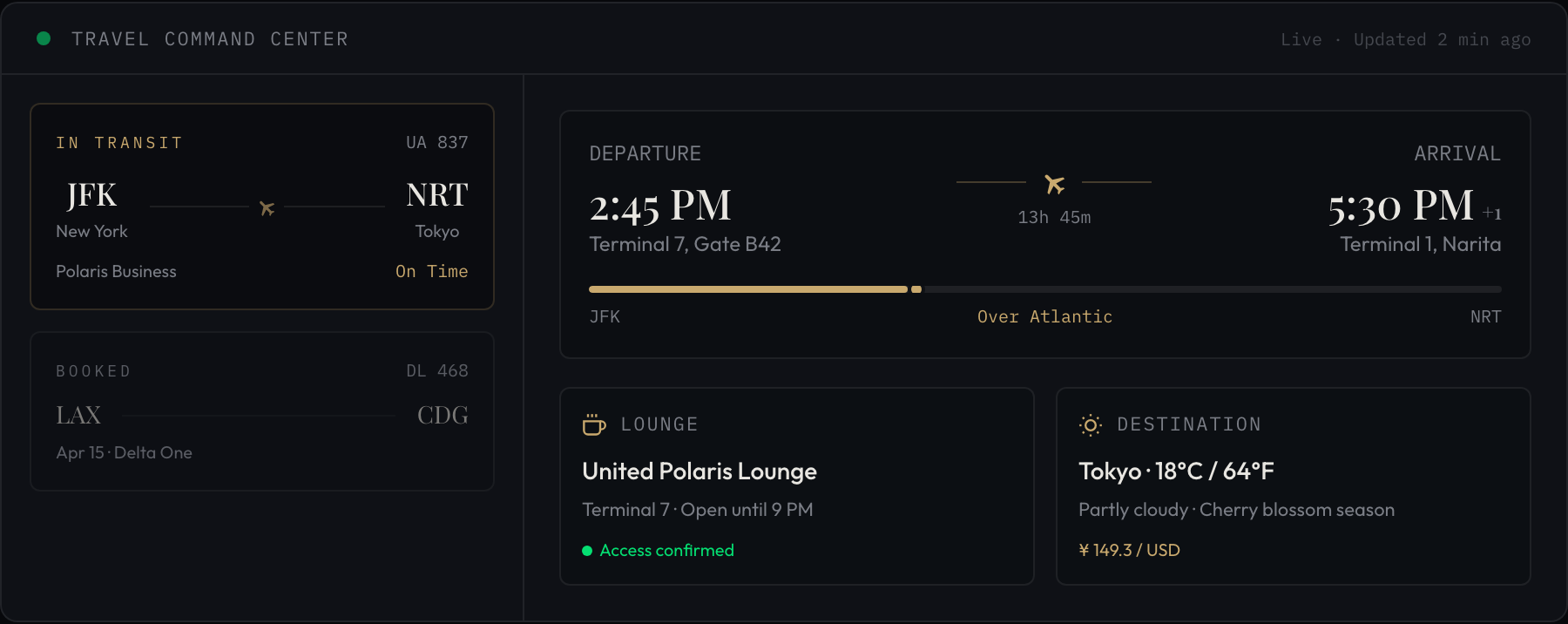
Now when you set an upgrade alert in the upgrade monitor, you also tell us your status tier and what instrument you're planning to use (miles, SWU, GPU, etc.), and we only fire the alert when the seat is actually accessible to you specifically.
The current version has sent 1,847 upgrade alerts since we relaunched it 6 weeks ago. Of those, 94.3% were for seats the user could actually book. That 5.7% failure rate still bothers me. The cause is latency: some airlines change fare class availability in the window between our check and when the user clicks through. We poll every 4 minutes on high-demand routes and every 22 minutes on thinner routes. We're testing a 90-second poll cycle on a subset of transatlantic routes this month.

The Elite Status Tracker: The Feature That Taught Me to Slow Down
Back in March, when I wrote about tracking 47 airline programs, I mentioned that the data infrastructure was the hard part. The status tracker is where that infrastructure finally pays off in a way users can actually see.
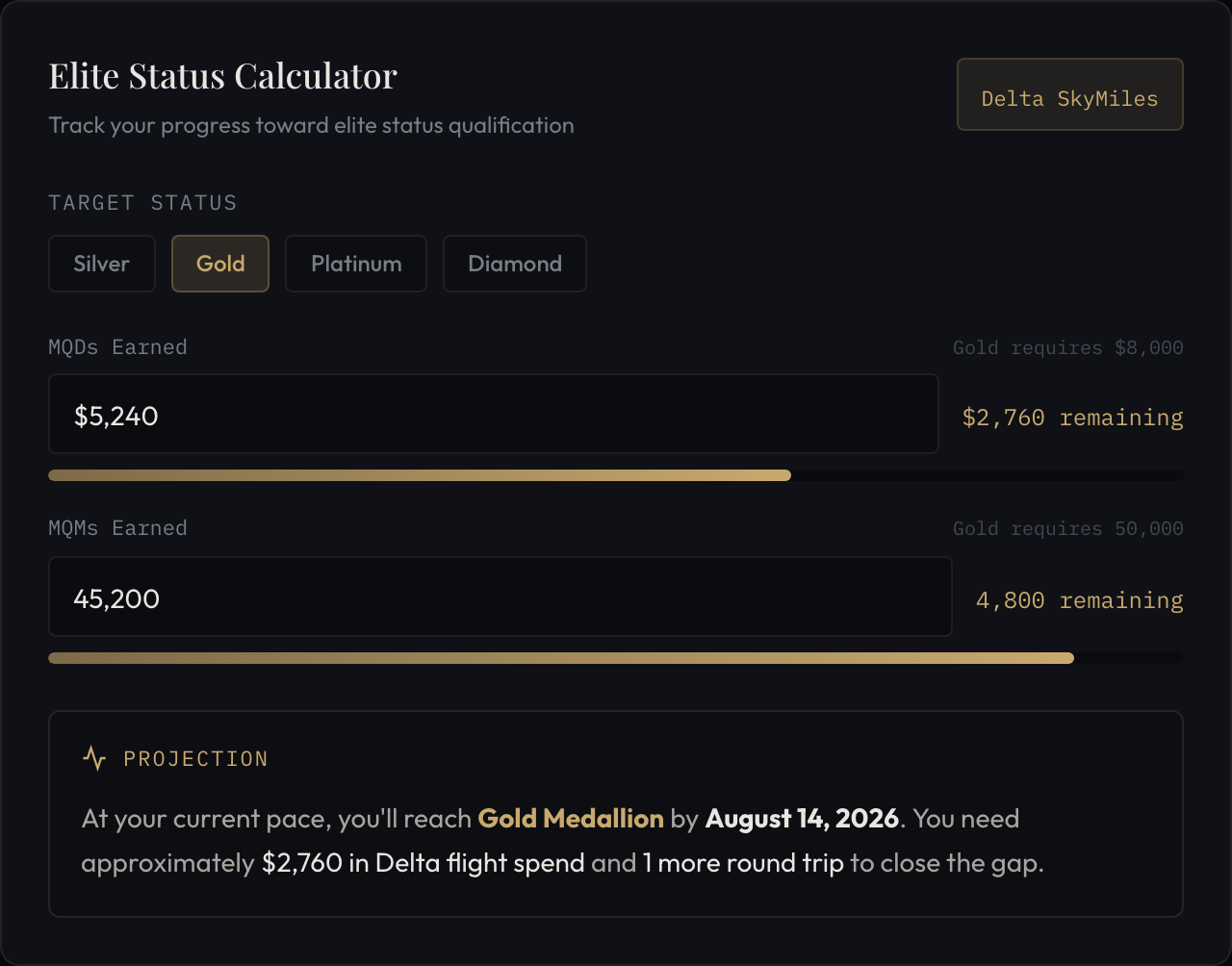
The core idea: you tell us your current status, your qualifying metrics so far this year (PQP, EQM, EQS, segments, whatever the program uses), and your target status tier. We project your qualification date based on your historical earning pace and flag if you're on track, behind, or need a mileage run.
Here's how the major U.S. programs structure their qualification requirements, since these vary more than most people realize:
| Program | Primary Metric | Secondary Requirement | Rollover? | Merger Risk Level |
|---|---|---|---|---|
| United MileagePlus | PQP (Premier Qualifying Points) | 4 PQFs for top tiers | Yes, up to Silver threshold | Low (stable) |
| Delta SkyMiles | MQD (Medallion Qualifying Dollars) | None since 2023 | Yes | Low (stable) |
| American AAdvantage | LP (Loyalty Points) | None | Yes | Medium (DL/AA spec rumors) |
| Alaska Mileage Plan | EQM + EQS or EQD | Segments required for Gold+ | No | High (HawaiianMiles absorbing) |
| HawaiianMiles | Pualani tiers via segments | Miles flown | No | Critical (mid-conversion now) |
| Sun Country Rewards | Segment-based tiers | No formal elite program | No | High (Allegiant merger pending) |
| Allways Rewards | Points-based, no published status tiers | N/A | No | High (merger pending) |
What I didn't anticipate was how much users would care about the multi-program view. I built it thinking people track one program seriously. Turns out a meaningful chunk of our users are managing status runs across two or three programs simultaneously, usually because they're trying to match status from a merger or a new credit card benefit.
Which brings me back to Allegiant and Sun Country.
When these programs eventually combine, there will be a window where status from one program can be matched to the other. Based on prior mergers, here's what that window typically looks like in practice:
| Merger Stage | Typical Timeline | What You Need Ready |
|---|---|---|
| Merger announced | Day 0 | Screenshot current points balances and status certificates |
| DOT approval | 6-18 months post-announcement | Confirm account numbers in both programs are active |
| Status match window opens | Usually 30-90 days post-approval | Current status documentation + qualifying activity proof |
| Status match window closes | Often with 2 weeks notice or less | Must act immediately; no extensions |
| Programs merge | 12-36 months post-approval | Points convert at published ratio; verify within 72 hours |
The users who have their status data already loaded into the status calculator will be positioned to act on that match window the day it opens. Everyone else will find out about it on a FlyerTalk thread three weeks after the deadline.
I'm not overselling this for Allways and Sun Country specifically. These are small programs. But the Alaska-Hawaiian integration is a live test case right now, and the status match window for HawaiianMiles members has already opened. If you fly Hawaiian regularly and haven't checked the status calculator this week, do it today.

The Numbers This Week
Three Things to Do Right Now If You're Mid-Merger
If you're holding status or a meaningful points balance in Alaska, Hawaiian, Allegiant, or Sun Country, here are the specific steps worth taking this week:
- Load your current balances into the status calculator. Takes 3 minutes. If a status match window opens with 14 days notice, you want your baseline already documented, not scrambled together the morning you see the announcement.
- Set a points-value alert for any program you're accumulating in. We track redemption value benchmarks across all 47 programs. If HawaiianMiles drops below 0.9 cents per mile (the historical floor before conversion announcements), we'll flag it. Use the program tracker to set your threshold.
- Screenshot your account dashboard in both merging programs today. This sounds low-tech because it is. Merger portals sometimes lose historical data during system migrations. United-Continental members lost upgrade instrument records in 2012. Having a timestamped local copy has bailed out more than a few readers who've written in.
What I'm Still Figuring Out
The honest answer to "are you ready for the Allegiant-Sun Country merger" is: mostly.
The status tracker handles multi-program tracking well. The upgrade monitor works for the 12 programs we've mapped deeply. But our coverage of Allways Rewards specifically is thin. It's a small program, not a lot of user demand historically, so we deprioritized it. That's the right call in a resource-constrained world, but it means we'll be scrambling to add proper fare-class support if the merger timeline accelerates.
I've also been thinking about a harder problem: what do you tell users when a program they're tracking disappears? Not devalues. Disappears. Their points get converted at some ratio, their status gets matched or doesn't, and the program they've been optimizing for no longer exists. The Alaska-Hawaiian integration is giving us a live test case right now.
If you're tracking status in a program that's currently mid-merger, I'd genuinely love to hear what information you wish you had. The status calculator is free to use, and I read every piece of feedback that comes in.
What's the one thing you wish a tool like this would tell you during a merger?
Get articles like this in your inbox
The Mileage Run — one short email when something actually changes your travel math. No filler, no affiliate trash, no spam. Unsubscribe anytime.
Frequently Asked Questions
What happens to loyalty programs when airlines merge?+
When airlines merge, loyalty programs run in parallel before one absorbs the other. During this process, earning rates shift, redemption values change, status matches are offered and expire, and members' points can lose 20-40% of their value without warning. Historical examples include Alaska-Virgin America (18 months of uncertainty), United-Continental, and American-US Airways mergers.
Why did the upgrade monitor take longer to build than expected?+
The initial version only checked for seat availability but didn't account for airline-specific rules. 'Upgrade available' means different things depending on the airline, fare class booked, status tier, and redemption instrument used. The rewritten version layers in eligibility rules for 12 major programs so alerts only fire for seats users can actually book.
How accurate is MileIntel's upgrade monitor?+
The current version has achieved 94.3% accuracy across 1,847 upgrade alerts sent over 6 weeks. The 5.7% failure rate occurs when airlines change fare class availability between MileIntel's check and when the user attempts to book, a problem the team is actively working to solve.
Why does the Allegiant-Sun Country merger matter for MileIntel users?+
While Allegiant and Sun Country's loyalty programs aren't major players, the merger follows a predictable pattern of program consolidation that historically reduces point values and creates member uncertainty. MileIntel's upgrade monitor and elite status tracker are specifically designed to help users navigate these disruptions.
Don't Miss a Departure
Track your miles, catch devaluations before the blogs do, and find the best use of every point you have.
Create Your Free AccountSign up with Google · No credit card required