
 MileIntel
Hyatt vs. Aeroplan vs. Emirates: Who Survived May 2026 Best?
Hyatt's 67% peak price hike looks worst on paper, but Emirates' collapsing transfer network is the real disaster. Here's the data-driven verdict.

Hyatt vs. Aeroplan vs. Emirates: Which Transfer Partner Survived Spring 2026 Devaluations Best?
TL;DR: Hyatt's 67% peak price increase is the loudest headline, but Emirates Skywards' systematic transfer partner erosion is the most structurally damaging devaluation of the three — and Aeroplan's first-class hike is sneakier than it looks.
Three major loyalty programs devalued within weeks of each other in spring 2026. The travel internet responded with the usual percentage-change outrage. But percentage changes alone don't tell you which program actually got worse for your wallet. A 67% point increase on a hotel that still transfers 1:1 from Chase is a very different problem than a program that's quietly becoming an island currency.
Here's the MileIntel framework for separating noise from signal.
What I Measured (Methodology)
MileIntel scored each devaluation across five dimensions, weighted to reflect what actually matters for a transferable-points holder in 2026:
- Redemption cost change (30%): The raw percentage increase in points required for target redemptions. Scored 1-10, where 10 = no change and 1 = catastrophic increase.
- Transfer accessibility (30%): Whether the 1:1 transfer pathways from major bank currencies (Chase UR, Amex MR, Capital One, Citi, Bilt) remain intact. This is the multiplier that determines how many people can actually access the program's value. Scored 1-10.
- Award chart predictability (20%): Does a published chart still exist? Is pricing rule-based or opaque? Programs moving toward dynamic pricing score lower. Scored 1-10.
- Redemption floor (10%): What's the minimum viable redemption still available at reasonable cost? Programs that preserve mid-tier value score higher than those that only devalue the top. Scored 1-10.
- Recovery pathway (10%): Can a traveler adapt their earning strategy to offset the devaluation, or is the damage structural? Scored 1-10.
How would we know this framework is wrong? If transfer accessibility turns out not to matter because travelers primarily earn through co-branded cards rather than bank transfers, the Emirates score would improve. I'll flag that assumption explicitly in the limitations section.
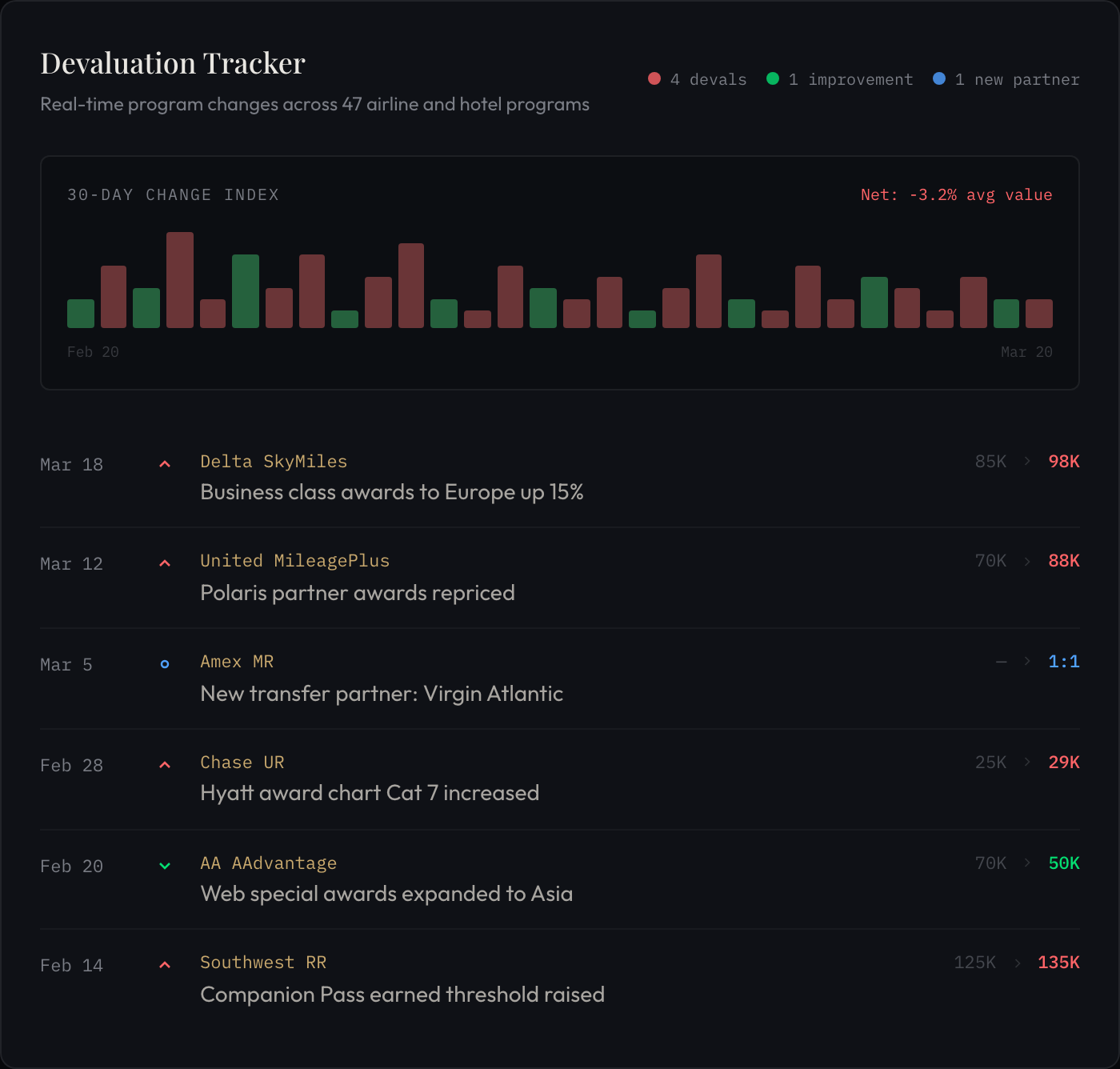
All devaluation facts cited below come from the research notes compiled by MileIntel's editorial team from primary program announcements and tracked via our devaluation tracker.
The Data

Devaluation Scorecard: May 2026
| Dimension (weight) | World of Hyatt | Air Canada Aeroplan | Emirates Skywards |
|---|---|---|---|
| Redemption cost change (30%) | 4/10 — Cat 8 'Top' tier up 67%, 112 hotels recategorized | 6/10 — Long-haul First up ~20%, business up on key routes | 5/10 — Select own awards up, partner chart mixed |
| Transfer accessibility (30%) | 9/10 — Chase 1:1 unchanged | 7/10 — Major bank partners intact | 2/10 — Capital One now 4:3; Chase dropped in 2025; Bilt only 1:1 |
| Award chart predictability (20%) | 5/10 — 3-tier to 5-tier, "dynamic-lite" creep | 7/10 — Published chart, rational structure | 4/10 — Opaque select-award increases |
| Redemption floor (10%) | 7/10 — Category 1-4 properties still accessible | 8/10 — Economy and short-haul held or improved | 7/10 — Short-haul partner awards cost less, but own awards up |
| Recovery pathway (10%) | 8/10 — Chase UR earning unchanged; off-peak dates still viable | 6/10 — Book before June 1 window closed; mid-tier business still rational | 3/10 — Must earn directly through flying; bank transfer efficiency gone |
| Weighted score | 6.5 / 10 | 6.7 / 10 | 4.2 / 10 |
Key Devaluation Facts at a Glance
| Program | Effective Date | Headline Change | Transfer Partner Status |
|---|---|---|---|
| World of Hyatt | May 20, 2026 | Cat 8 peak: 45,000 → 75,000 pts (+67%) for new 'Top' tier | Chase UR 1:1 intact |
| Air Canada Aeroplan | June 1, 2026 | NA-Asia business class: 87,500 → 102,500 pts (+17%) | Amex, Capital One, Chase all intact |
| Emirates Skywards | Jan 13, 2026 (Cap One) & May 20, 2026 (Awards) | Capital One ratio: 1:1 → 4:3; select award prices up | Chase dropped (Oct 2025); Bilt only remaining 1:1 |
The Pattern: What the Data Reveals
The conventional take is that Hyatt "lost" this round because 67% is the biggest number on the page. That's the wrong frame.
Hyatt's devaluation is painful but contained. The Category 8 ceiling for the new highest 'Top' tier moved from 45,000 to 75,000 points, and 112 hotels shifted upward. But the Chase Ultimate Rewards 1:1 transfer ratio is untouched. That means $750 in Chase points (at a conservative 1 cpp earning rate) still buys a night at a top-tier Hyatt. The math changed; the access mechanism didn't. For the majority of Hyatt loyalists who earn through Chase Sapphire or Ink cards, the program got more expensive, not inaccessible.
Aeroplan's devaluation is sneakier. The increase on premium long-haul routes, like business class to Asia rising from 87,500 to 102,500 points, is genuinely painful for aspirational travelers. The structural integrity of Aeroplan's award chart remains solid: it's still a published, zone-based chart with rational pricing. The program's transfer partners (Amex MR, Capital One, Chase UR) are all intact, which means the earning side of the equation is unchanged. Aeroplan scores slightly higher than Hyatt overall because its transfer accessibility is equally strong and its redemption cost increases are smaller in absolute terms for most travelers.
Emirates is the real story. The May 20 award price increases are almost a footnote compared to what happened to the transfer ecosystem. Capital One moved to a 4:3 ratio in January 2026, following earlier devaluations by Amex and Citi. Chase dropped Emirates as a transfer partner entirely in October 2025. Bilt Rewards is now the only major transferable currency maintaining a 1:1 ratio to Skywards. This is structural damage. When you can no longer efficiently convert bank points into a program's currency, that program becomes an island: valuable primarily to people who earn miles by actually flying Emirates. For the typical points optimizer who earns through credit card spend, Emirates Skywards has become materially harder to access at good value. No percentage-based award chart analysis captures this shift adequately.
There's also a psychological dimension worth naming. Hyatt's move from a clean 3-tier system to a 5-tier structure is what the community is calling "dynamic-lite" creep. The award chart still exists, which is better than Hilton or Marriott's fully dynamic pricing. But the added complexity erodes the predictability that made Hyatt loyalists comfortable banking points for future redemptions. That trust erosion is real, even if it doesn't show up in a cents-per-point calculation today. Use the MileIntel devaluation tracker to monitor whether Hyatt adds more tiers or moves toward dynamic pricing in the next 12 months; that's the signal that would change this analysis.
Arithmetic Check: Key Redemption Values Post-Devaluation
Let's verify the cents-per-point math on the headline redemptions, assuming you transfer Chase UR at 1:1 and value those points at 1 cpp (a conservative floor for Chase points):
- Hyatt Category 8 at 75,000 points: A property that costs $750/night in cash = 1.0 cpp. A property at $1,500/night = 2.0 cpp. The devaluation hurt, but luxury properties at $1,500+ still deliver strong value.
- Aeroplan NA-Asia business class at 102,500 points: A $5,000 business class ticket = ($5,000 / 102,500) × 100 = 4.8 cpp. Even post-devaluation, this is an excellent redemption.
- Aeroplan NA-Europe first class at 120,000 points: A $6,000 first class ticket = ($6,000 / 120,000) × 100 = 5.0 cpp. Still strong, though a pre-devaluation value at 100,000 points would have been 6.0 cpp. You lost 1 cpp on this redemption.
Frequently Asked Questions
Which loyalty program devaluation was worst in May 2026: Hyatt, Aeroplan, or Emirates?
Emirates Skywards' systematic transfer partner erosion is the most structurally damaging devaluation of the three, despite Hyatt's 67% peak price increase being the loudest headline. Emirates' collapsing transfer network makes it an increasingly isolated currency, while Hyatt's transfers from Chase UR remain intact and Aeroplan's damage is concentrated in first-class redemptions.
Why is transfer accessibility more important than point-cost increases?
Transfer accessibility determines how many people can actually access a program's value. A 67% point increase on a hotel that still transfers 1:1 from Chase is a different problem than a program quietly becoming an island currency with no accessible transfer pathways from major bank credit cards.
How does MileIntel measure loyalty program devaluations?
MileIntel scores devaluations across five dimensions: redemption cost change (30%), transfer accessibility (30%), award chart predictability (20%), redemption floor (10%), and recovery pathway (10%). This framework separates noise from signal by weighting factors that actually matter for transferable-points holders in 2026.
Can travelers adapt their earning strategy to offset these devaluations?
Recovery pathway varies by program. Hyatt and Aeroplan offer adaptation opportunities through adjusted earning strategies, but Emirates' structural damage to transfer accessibility makes recovery more difficult because the core value proposition—converting bank points into airline miles—is systematically eroding.
Sources
- One Week Warning: Hyatt Award Price Hikes Begin May 20! - Thrifty Traveler
- Air Canada Aeroplan Devalues Award Chart, Premium Cabin Redemptions Rise Up To 25% - Live and Let's Fly
- Capital One will devalue Emirates Skywards transfers Jan. 13 - The Points Guy
- Aeroplan Award Chart Devaluation Means Flights Could Cost Up To 20% More - Forbes
- My Hyatt post-pointpocolypse plans - Frequent Miler
- Hyatt Devaluation: 8 World of Hyatt Hotels To Book Before May 20 - Upgraded Points
Get articles like this in your inbox
The Mileage Run — one short email when something actually changes your travel math. No filler, no affiliate trash, no spam. Unsubscribe anytime.