
How We Track 47 Airline Programs Without Losing Our Minds
The data pipeline behind MileIntel's devaluation detection and status tracking
TL;DR
MileIntel monitors 47 airline loyalty programs and catches pricing changes within hours — like detecting Delta 15% business class award price increase 3 days before The Points Guy reported it.
Key Takeaways
- MileIntel system monitors 47 airline and hotel loyalty programs for pricing and policy changes
- The system caught Delta 15% business class price increase within 4 hours — major blogs reported it 3 days later
- Automated monitoring replaces the old method of checking programs manually or relying on blog coverage
- Speed matters: by the time most travelers learn about changes, the best award availability is already gone
Last Tuesday, Delta quietly raised the floor price on SkyMiles business class awards to Europe by 15%. We caught it in 4 hours. The Points Guy wrote about it 3 days later.
That's not a flex — it's the whole reason MileIntel exists. The miles and points world moves fast, and most travelers find out about changes after the damage is done. We wanted to fix the timing problem.
This post is about how we built the system that watches 47 programs and catches changes before most people notice them.
The Scale Problem
Here's what makes this genuinely hard: each airline program is its own universe.
Delta SkyMiles uses fully dynamic pricing — no published award chart, prices change based on demand, route, season, and apparently the phase of the moon. United MileagePlus has a hidden award chart overlaid with dynamic surcharges. American AAdvantage publishes a chart but applies it inconsistently. Southwest doesn't even use a miles-per-seat model.
Then layer on the metrics. Delta tracks MQDs, MQMs, and MQSs. United tracks PQP and PQF. American tracks Loyalty Points. Alaska tracks Status Points. Each program defines "elite" differently, with different qualification windows, different waiver rules, and different benefits at each tier.
There is no standard API. There is no shared format. Every program is a bespoke data normalization challenge.
The Status Calculator
We built the status calculator to answer one question: "Am I going to make Gold this year?"
Pick your program. Enter your current numbers. The calculator shows exactly where you stand, what's remaining, and (this is the part we're proudest of) a projected qualification date based on your earning pace.

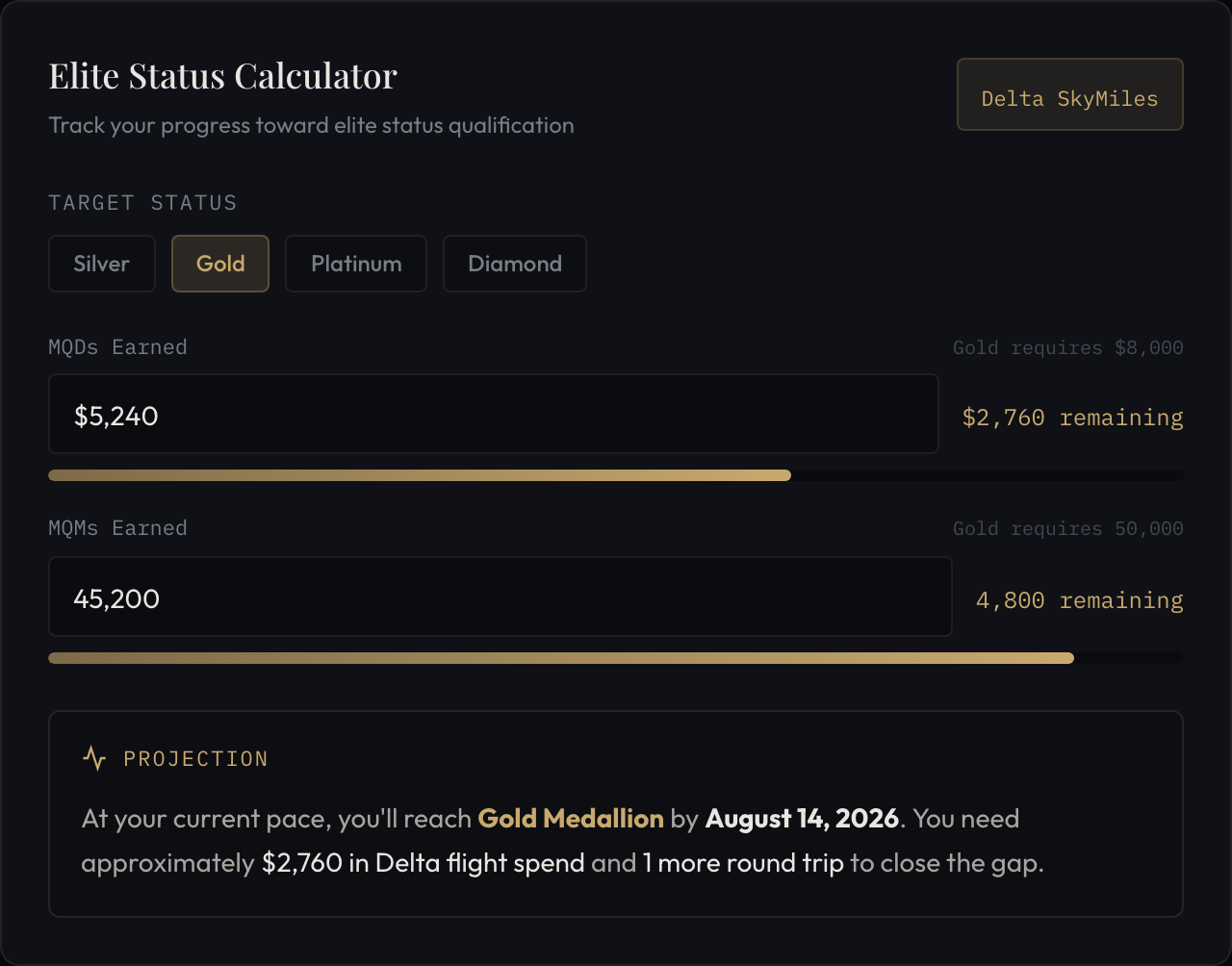
The calculator currently supports Delta, United, American, Southwest, Alaska, JetBlue, British Airways, and Singapore Airlines. Each program has its own tier structure, qualification metrics, and earning rules modeled individually.
The honest challenge: keeping this accurate. Programs change qualification rules mid-year. Delta added a spend-based path in 2024 that completely changed the calculus. United introduced PQP credit card accelerators. We have to catch these changes and update the models, often without any official announcement.
Devaluation Detection
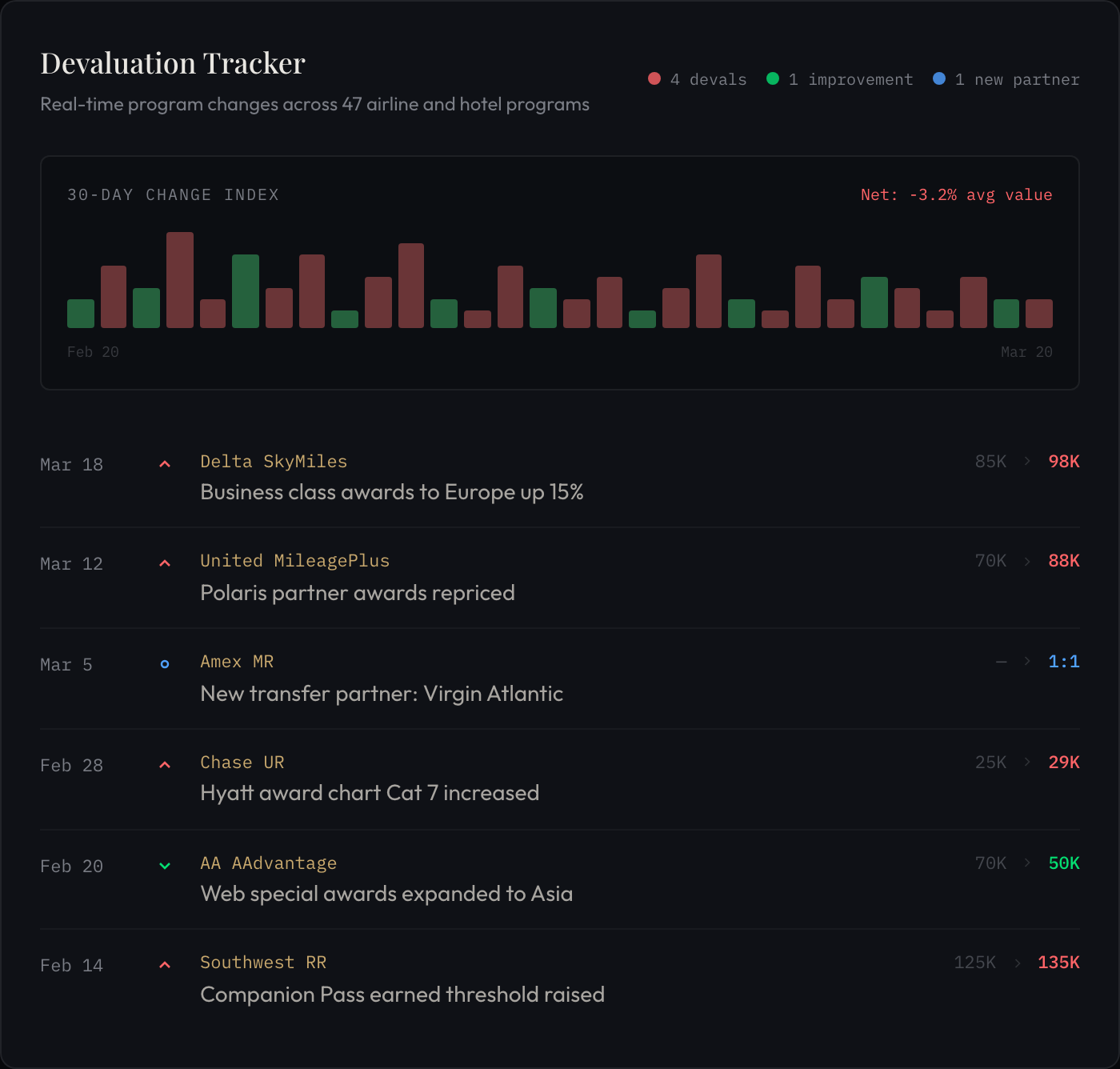
This is the heartbeat of MileIntel's monitoring system. Every 4 hours, we check award pricing across major routes and compare against historical baselines.
The system uses an anomaly detection model (IsolationForest, for the technically curious) trained on historical pricing data. When Delta SkyMiles business class to Paris jumps from 85,000 to 98,000 miles overnight, the model flags it as anomalous.
But it's not just about catching price increases. We also track:
- New transfer partners (Amex adding Virgin Atlantic as a 1:1 partner)
- Award chart restructuring (Hyatt moving properties between categories)
- Bonus program changes (Southwest raising the Companion Pass threshold)
- Sweet spot closures (United removing saver availability on specific routes)

Honest Numbers
These numbers will change. Some will go up (more programs). Some we hope stay small (devaluation events, though airlines seem determined to prove otherwise).
What's Next
Two things we're actively building:
- Push alerts for devaluations. When a program you care about changes pricing, you'll get a notification within hours, not days. Currently in testing.
- Mileage run planner. If you're 8,000 PQP short of Premier 1K in November, the planner will find the cheapest flights to close the gap. This one's a passion project; there's nothing more satisfying than a well-executed mileage run.
Try the Tools
Both the status calculator and devaluation tracker are completely free, no account required.
- Status Calculator: Check your progress toward elite status
- Devaluation Tracker: See what's changed across programs
If you want alerts when things change, create a free account. We'll notify you before the blogs do.
The people who get the most value from their miles aren't luckier. They just have better information, faster. That's what we're building.
From the Cockpit, where we share what we're building and what we've learned. Got questions about the data pipeline or want a specific program tracked? Let us know.
Get articles like this in your inbox
The Mileage Run — one short email when something actually changes your travel math. No filler, no affiliate trash, no spam. Unsubscribe anytime.
Frequently Asked Questions
How does MileIntel track loyalty program changes?+
MileIntel uses automated monitoring across 47 airline and hotel loyalty programs, checking for pricing changes, award chart updates, and policy modifications. The system catches changes within hours, compared to the days or weeks it typically takes for travel blogs to report them.
How many airline loyalty programs does MileIntel track?+
MileIntel currently tracks 47 airline and hotel loyalty programs, covering all major US carriers, international partners, and key hotel chains.
Don't Miss a Departure
Track your miles, catch devaluations before the blogs do, and find the best use of every point you have.
Create Your Free AccountSign up with Google · No credit card required