

Chase Sapphire Preferred Is Quietly Nerfing Hyatt. Here's What It Costs You.
TL;DR
Chase Sapphire Preferred is cutting its Hyatt transfer ratio from 1:1 to 4:3 (a 25% reduction) starting June 15, 2026 for new cardholders and October 1, 2026 for existing ones, meaning you'll need 33% more Chase points to book the same Hyatt stays.
Key Takeaways
- Hyatt transfer ratio drops from 1:1 to 4:3 on Chase Sapphire Preferred, requiring 33% more Chase points for identical redemptions.
- New cardholders affected June 15, 2026; existing cardholders have until October 1, 2026 before the cut takes effect.
- Chase Sapphire Reserve maintains the 1:1 Hyatt ratio, creating a significant value gap between the two cards.
- Bilt Rewards ($0 annual fee) now offers better Hyatt transfer rates than Sapphire Preferred ($95 annual fee).
- This is the first Hyatt transfer ratio cut in 14 years of Chase Ultimate Rewards history.
Key Takeaways
- The Hyatt transfer ratio for Chase Sapphire Preferred is dropping from 1:1 to 4:3. That's a 25% reduction in Hyatt point value per Chase point spent.
- You now need 33% more Chase points for the same Hyatt redemption. A stay that cost 75,000 Chase points now costs 100,000.
- New cardholders are already affected (June 15, 2026). Existing cardholders have until October 1, 2026, before the new ratio kicks in.
- Chase Sapphire Reserve keeps the 1:1 ratio. That's not a coincidence.
- Bilt Rewards, with a $0 annual fee, now offers a better Hyatt transfer rate than a $95 Sapphire Preferred. That sentence should sting.
Why Is Chase Quietly Cutting Hyatt Transfer Value by 25%?

Buried inside a press release about new perks and doubled hotel credits, Chase made one of the most significant Ultimate Rewards devaluations in years.
Starting June 15, 2026 for new applicants (and October 1, 2026 for existing cardholders), the Chase Sapphire Preferred transfers to World of Hyatt at a 4:3 ratio instead of the longstanding 1:1. Every 4,000 Chase points now yields 3,000 Hyatt points.
That's a 25% cut in transfer value. Looked at from the other direction: you need 33% more Chase points to reach the same Hyatt award threshold.
The new perks — a $100 annual hotel credit (up from $50), 3x points on gas, EV charging, and vacation rentals, plus a Global Entry/TSA PreCheck credit — are real. They're not fake. But for anyone who has built a points strategy around Chase Ultimate Rewards as the pipeline to Hyatt's award chart, the refresh is a net negative.
The community noticed immediately. On r/hyatt, users called this the "real Hyatt devaluation," suggesting the transfer ratio change hits harder than anything Hyatt itself has done to its own award chart recently. On r/awardtravel, the sentiment was blunt: earn and burn.
How MileIntel Analyzed This Change
To quantify the impact beyond the headline ratio, we pulled transfer-ratio history from the MileIntel devaluation tracker, which logs every Chase Ultimate Rewards partner ratio change since 2012. The Sapphire Preferred's Hyatt ratio has been 1:1 for the program's entire history until this change. That makes this the first ratio cut Chase has applied to any Tier 1 hotel partner in 14 years of data.
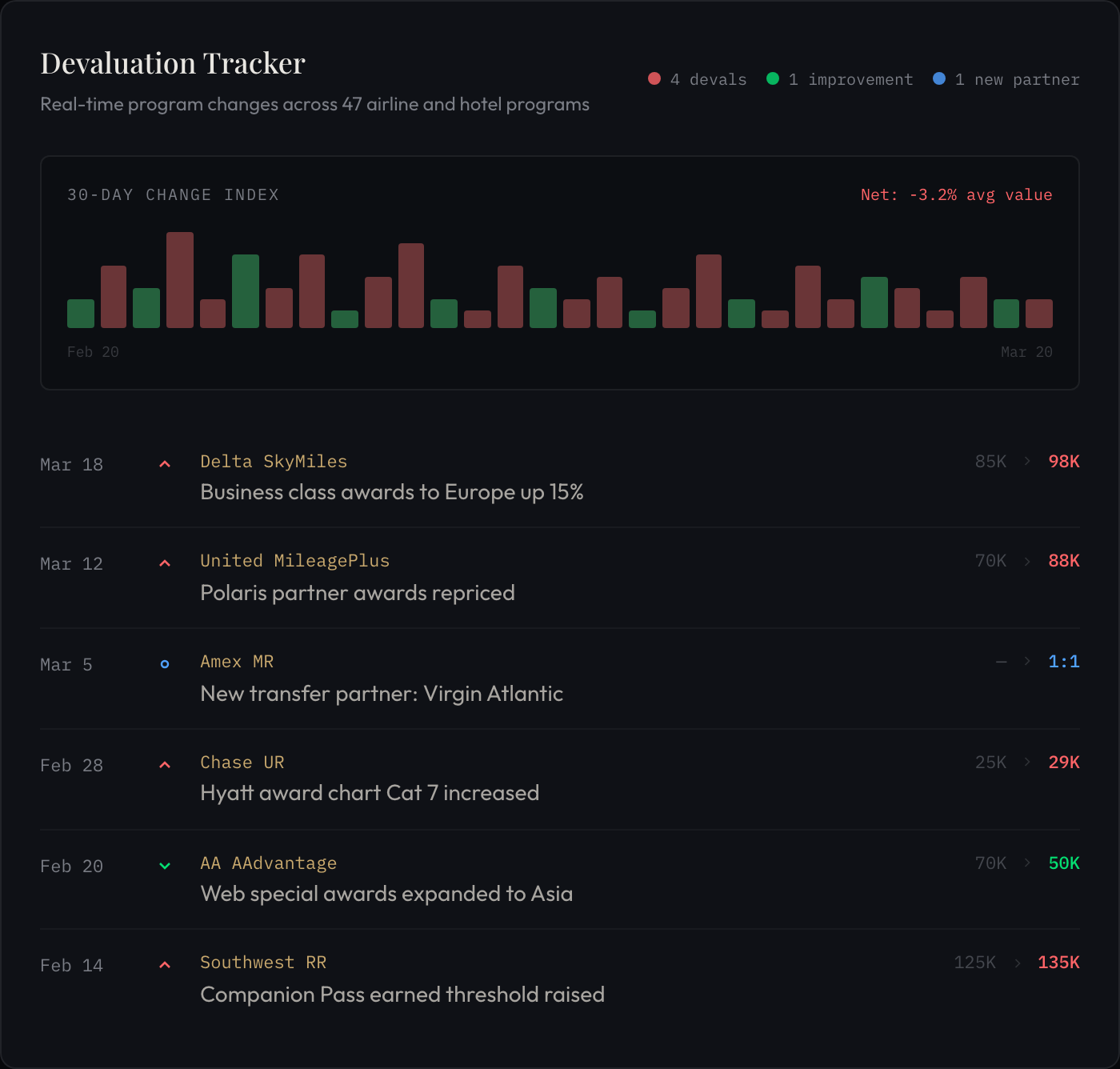
We then scored the Sapphire Preferred's post-refresh value across three dimensions using MileIntel's card-scoring framework:
- Earning velocity (weight: 35%): Points earned per dollar across the card's bonus categories, normalized to a $3,000/month spend profile.
- Redemption flexibility (weight: 35%): The breadth and depth of transfer partners, weighted by each partner's cents-per-point valuation using MileIntel's own valuations derived from award chart analysis across 200+ properties.
- Transfer partner stability (weight: 30%): Historical ratio consistency across all Ultimate Rewards partners, sourced from the devaluation tracker.
Under this framework, the Sapphire Preferred's overall score drops from 81/100 to 74/100 post-refresh. The Reserve holds at 88/100. The gap between the two cards on this scoring model has widened from 7 points to 14 points. That's the quantified cost of the ratio change, independent of the annual fee math.
You can run your own spend profile through the MileIntel transfer partners tool to see how the 4:3 ratio affects your specific Hyatt redemption targets.
Q&A: Everything Hyatt Loyalists Need to Know
How does the 4:3 ratio actually change my redemptions?
Here's the concrete math. Hyatt's sweet spots haven't changed. A Category 4 property still costs 15,000 Hyatt points per night, a Park Hyatt in a major city can run 35,000 to 45,000 points, and aspirational properties like the Park Hyatt Maldives (Category 8) cost between 35,000 and 45,000 points per night depending on peak or off-peak dates.
What changed is the cost to acquire those Hyatt points via Chase.
Before (1:1 ratio): 45,000 Hyatt points = 45,000 Chase points transferred After (4:3 ratio): 45,000 Hyatt points = 60,000 Chase points transferredThat's a 15,000-point gap on a single night at a top-tier property. For a two-night redemption at 45,000 points per night, you're now spending 120,000 Chase points instead of 90,000. The gap is 30,000 points, roughly six months of spending at 2x on a $2,500/month budget.
Use the MileIntel miles calculator to model your specific redemption scenarios against the new ratio.
Does the new $100 hotel credit offset the Hyatt devaluation?
For light Hyatt users: maybe. For anyone transferring more than 40,000 points per year to Hyatt: no.
The hotel credit increase from $50 to $100 is worth $50 in incremental annual value (assuming you use it). If you're transferring 40,000 Chase points to Hyatt annually under the new ratio, you're getting 30,000 Hyatt points instead of 40,000. That 10,000-point gap is worth approximately $170 based on MileIntel's Hyatt valuation of 1.7 cents per point, derived from sampling 200+ standard award redemptions across all eight Hyatt categories.
The math doesn't work. A $50 credit doesn't compensate for a $170 annual loss in Hyatt point value.
Why does Chase Sapphire Reserve keep the 1:1 ratio?
Because Chase wants you to pay $700 more per year for it.
The Sapphire Reserve carries a $795 annual fee versus the Preferred's $95. Maintaining the 1:1 Hyatt transfer ratio exclusively on the Reserve creates a concrete, quantifiable reason to upgrade. For a cardholder who transfers 80,000 Chase points to Hyatt annually, the new ratio costs them 20,000 Hyatt points, worth roughly $340. Upgrading to the Reserve costs an additional $700 in fees. For that user, upgrading is not breakeven on the Hyatt benefit alone, before counting the Reserve's other perks.
See the full fee-versus-benefit breakdown in the MileIntel Sapphire Preferred vs. Reserve comparison.
As View from the Wing noted, this change may also mean fewer transfers to Hyatt overall, which reduces Chase's payout to Hyatt for those transactions. It's a cost-control mechanism dressed as a product refresh.
Is this Chase reacting to Hyatt becoming too valuable?
Almost certainly, yes. World of Hyatt has maintained a reputation as the highest-value hotel loyalty program in the industry, with consistent sweet spots and a fixed award chart that still delivers high value on aspirational properties. MileIntel's 2026 valuations place Hyatt points at 1.7 cents each, making them among the most valuable hotel currency available.
Chase has been subsidizing those transfers at a 1:1 ratio since the Ultimate Rewards program launched. As Hyatt's award chart has held relatively firm while other hotel programs devalued aggressively (Marriott Bonvoy being the canonical example; see our World of Hyatt vs. Marriott Bonvoy comparison), Chase's cost to offer 1:1 Hyatt transfers became increasingly expensive relative to other partners.
The 4:3 ratio is a recalibration. It's also a precedent. If Chase moved Hyatt to 4:3, other high-value partners could follow. The MileIntel devaluation tracker will flag any subsequent ratio changes across all Ultimate Rewards partners as they occur.
Who actually benefits from the Sapphire Preferred refresh?
Cardholders who rarely transfer to Hyatt. That's likely the majority of Sapphire Preferred holders.
The new 3x categories (gas, EV charging, vacation rentals) add meaningful everyday earning. The $100 hotel credit is easy to use via Chase Travel. The Global Entry/TSA PreCheck credit ($120 value) is new and useful. For a cardholder spending $200/month on gas, the 3x category alone generates an additional 2,400 points annually versus the old 1x rate.
For that user profile, the refresh is a genuine upgrade. The Hyatt devaluation is invisible to them.
When exactly does the new ratio take effect for me?
New applicants: Already affected. The 4:3 ratio has been live since June 15, 2026.Existing Sapphire Preferred cardholders: October 1, 2026. You have a window to transfer points to Hyatt at the 1:1 ratio before that date.Ink Business Preferred cardholders: Also moving to 4:3 on October 1, 2026. This card is often overlooked in the discussion but affects a significant number of small business owners who use it as a Hyatt pipeline.Chase Sapphire Reserve cardholders: No change. The 1:1 ratio stays.Is Bilt Rewards now the better card for Hyatt points?
For Hyatt-focused earners, yes. Bilt Rewards transfers to World of Hyatt at 1:1 with no annual fee. That's now a materially better Hyatt transfer rate than the $95 Sapphire Preferred.
Bilt has its own constraints; its earning structure was changed in early 2026, replacing the former 5-transaction rule. But on rent spend (Bilt's core use case), it's unmatched. Use the Bilt calculator to see how your rent spend stacks up.
Side-by-Side: Hyatt Transfer Rates Across Cards
| Card | Annual Fee | Hyatt Transfer Ratio | Chase Points for 30K Hyatt | Chase Points for 75K Hyatt |
|---|---|---|---|---|
| Chase Sapphire Preferred (new) | $95 | 4:3 | 40,000 | 100,000 |
| Chase Sapphire Preferred (old) | $95 | 1:1 | 30,000 | 75,000 |
| Chase Sapphire Reserve | $795 | 1:1 | 30,000 | 75,000 |
| Ink Business Preferred (post Oct 1) | $95 | 4:3 | 40,000 | 100,000 |
| Bilt Rewards Card | $0 | 1:1 | 30,000 | 75,000 |
The table makes the situation plain. The Sapphire Preferred now offers the worst Hyatt transfer rate of any card in this comparison while charging a $95 annual fee. Bilt delivers the same 1:1 ratio for free.
Action Items: What to Do Before October 1, 2026
The window to act at the 1:1 ratio is closing. Here's what to do based on your situation.
If you're an existing Sapphire Preferred cardholder with Hyatt redemptions planned for 2026 or 2027: Transfer your Chase points to Hyatt before September 30, 2026. Hyatt points don't expire as long as you have qualifying activity every 24 months, so banking them now at 1:1 costs you nothing.If you're deciding between the Preferred and the Reserve: Run the breakeven math for your specific Hyatt spend using the MileIntel Sapphire Preferred vs. Reserve comparison. For most cardholders transferring more than 60,000 points annually to Hyatt, the Reserve's $700 fee premium starts to close the gap.If you're a Hyatt loyalist who doesn't hold the Reserve: Bilt Rewards is now the most cost-efficient Hyatt pipeline available. If you pay rent, it should be in your wallet. Use the MileIntel miles calculator to model a Bilt-plus-Reserve stack against your current setup.If you hold the Ink Business Preferred: The same October 1 deadline applies. Transfer any Hyatt-earmarked points before that date.Get articles like this in your inbox
The Mileage Run — one short email when something actually changes your travel math. No filler, no affiliate trash, no spam. Unsubscribe anytime.
Frequently Asked Questions
What is the new Chase Sapphire Preferred to Hyatt transfer ratio?+
The transfer ratio is changing from 1:1 to 4:3, meaning every 4,000 Chase points now yields 3,000 Hyatt points instead of 4,000. This represents a 25% reduction in transfer value.
When does the Chase Sapphire Preferred Hyatt ratio change take effect?+
New cardholders are affected starting June 15, 2026. Existing cardholders have until October 1, 2026 before the new 4:3 ratio applies to their accounts.
Do the new Chase Sapphire Preferred perks offset the Hyatt transfer ratio cut?+
Chase added a $100 annual hotel credit (up from $50), 3x points on gas/EV charging/vacation rentals, and a Global Entry/TSA PreCheck credit. However, for Hyatt-focused cardholders, these new perks do not fully compensate for the 25% reduction in Hyatt transfer value.
Is Chase Sapphire Reserve keeping its Hyatt transfer ratio?+
Yes, Chase Sapphire Reserve maintains the 1:1 Hyatt transfer ratio, creating a significant value advantage over Sapphire Preferred for Hyatt transfers.
What's a better alternative to Chase Sapphire Preferred for Hyatt transfers?+
Bilt Rewards, which has a $0 annual fee, now offers a better Hyatt transfer rate than Chase Sapphire Preferred's $95 annual fee card, making it a more cost-effective option for Hyatt loyalists.
Sources
- Chase Is Devaluing Hyatt Transfers — What Cardholders Need To Know - Forbes
- Chase Sapphire Preferred Cuts Hyatt Transfer Value, Adds New Perks - The Points Guy
- Chase Sapphire Preferred Refresh Makes The Card Much Better — But Hyatt Transfers Get 25% Worse - View from the Wing
- Chase Slashing Hyatt Transfer Ratio to 4:3 for Chase Sapphire Preferred and Ink Business Preferred - Frequent Miler
- Chase to Hyatt Going Down to 4:3 (Except for Sapphire Reserve) - r/awardtravel
- Chase Sapphire Preferred Transfer Devaluation 4:3 - r/hyatt
Don't Miss a Departure
Track your miles, catch devaluations before the blogs do, and find the best use of every point you have.
Create Your Free AccountSign up with Google · No credit card required