

9 Transfer Bonuses Ranked by Real Value Delivered in 2026
TL;DR
A 55% Chase-to-Marriott transfer bonus ranks as one of the worst deals among nine active transfer bonuses in June 2026 when evaluated by actual cents-per-point value delivered rather than headline percentage, while lesser-known bonuses like Citi-to-Qatar (30%) and Amex-to-Flying Blue offer superior real value.
Key Takeaways
- Chase-to-Marriott's 55% bonus destroys value because Marriott points are valued at 0.7–0.8¢ while Chase Ultimate Rewards are worth 2.05¢, resulting in a post-conversion loss exceeding 20%.
- Evaluation methodology weights net cents-per-point after conversion (50%), redemption concreteness (25%), devaluation risk (15%), and information advantage (10%) — not headline bonus percentages.
- Citi-to-Qatar 30% bonus and Amex-to-Flying Blue with stacked Promo Rewards deliver superior value despite lower headline percentages due to stronger receiving program valuations.
- A bonus preserves value if post-conversion cents-per-point stays within 10% of source value; it destroys value if the gap exceeds 20%.
- Rove Miles' 50% Turkish Airlines offer requires no credit card to earn, offering an information advantage despite limited redemption history.
The Verdict Up Top
The consensus framing of June 2026's transfer bonus landscape is misleading. Coverage leads with the Chase-to-Marriott Bonvoy 55% bonus as a marquee offer — a high ratio, and one of the biggest numbers on the board. By one metric that framing is accurate. By every metric that actually matters, the 55% bonus is one of the worst deals in this entire cohort.
Meanwhile, a 30% Citi-to-Qatar bonus is expiring June 30. A powerful double-discount stack combines Amex's Flying Blue bonus with Flying Blue's monthly Promo Rewards. And a 2025-launched program called Rove Miles is offering 50% to Turkish Airlines Miles&Smiles with no credit card required to earn.
This analysis scores all nine active bonuses on a consistent methodology. The ranking inverts the conventional wisdom.
Methodology: How We Scored These Bonuses

Every bonus was evaluated on four dimensions:
1. Net cpp after conversion (50% weight). We applied the bonus ratio to the source program's point value, then compared the result to the receiving program's point value. Source valuations for June 2026 vary. The Points Guy (TPG) values Chase Ultimate Rewards at 2.05¢, Amex Membership Rewards at 2.0¢, and Citi ThankYou Points at 1.9¢. Upgraded Points values Amex at 2.2¢ and Chase at 2.0¢. Marriott Bonvoy points are valued between 0.7¢ and 0.8¢ by various sources. A bonus "preserves value" if the post-conversion cpp is within 10% of the source value. It "destroys value" if the gap exceeds 20%.2. Redemption concreteness (25% weight). Does a specific, bookable award exist right now that uses this bonus at a meaningful discount? A bonus with no confirmed sweet spot scores lower than one with a named route and a verified point cost.3. Devaluation risk on the receiving program (15% weight). Programs that have devalued within the last 18 months score lower. Speculative transfers into a devaluing program compound the value destruction.4. Visibility / information advantage (10% weight). Bonuses that most cardholders will miss — because they're offered by the airline rather than the bank, or because they require monitoring a separate page — score higher on this dimension. An information gap is an opportunity.Scoring scale: 1–10 per dimension. Final score = weighted sum. We'd know this framework was wrong if a low-scoring bonus consistently produced better real-world redemptions than a high-scoring one; we invite readers to surface those cases.
Limitations this framework doesn't address: valuations vary across sources; dynamic award pricing means any cpp calculation is a snapshot, not a guarantee; Rove Miles lacks enough redemption history to value confidently. See the full limitations section below.The Ranking: 9 Bonuses Scored Side-by-Side
| Bonus | Ratio | Expires | Source cpp | Post-Bonus cpp | Net Value Shift | Deval Risk | Score /10 | Verdict |
|---|---|---|---|---|---|---|---|---|
| Amex MR → Flying Blue | 1:1.25 | Jun 30 | 2.2¢ | 2.75¢ effective | +25% purchasing power | Medium | 8.4 | STRONG |
| Citi TY → Qatar Avios | 1:1.3 | Jun 30 | 1.9¢ | 2.47¢ effective | +30% purchasing power | Low-Med | 8.1 | STRONG |
| Chase UR → Virgin Atlantic | 1:1.3 | Jul 14 | 2.0¢ | 2.6¢ effective | +30% purchasing power | Low-Med | 7.2 | GOOD |
| Rove → Turkish Miles&Smiles | 1:1.5 | Jun 30 | N/A | N/A | Unrated | Unknown | 6.5* | EMERGING |
| Citi TY → Accor ALL | 2:1.5 | Jul 14 | 1.9¢ | Fixed €20/1,000 pts | Niche fixed value | Low | 5.8 | NICHE |
| Amex MR → Avianca LifeMiles | 1:1.15 | Jul 15 | 2.2¢ | 2.53¢ effective | +15% purchasing power | Medium | 5.6 | MODERATE |
| Marriott → United MileagePlus | 60k:37.5k | Jun 30 | 0.7¢ | ~0.44¢/Marriott pt | Structural loss | N/A | 3.1 | LAST RESORT |
| Amex MR → Marriott Bonvoy | 1:1.2 | Jun 30 | 2.2¢ → 0.7¢ | 0.84¢ | -62% value destruction | High | 1.8 | AVOID |
| Chase UR → Marriott Bonvoy | 1:1.55 | Jun 30 | 2.0¢ → 0.7¢ | 1.085¢ | -46% value destruction | High | 1.4 | TRAP |
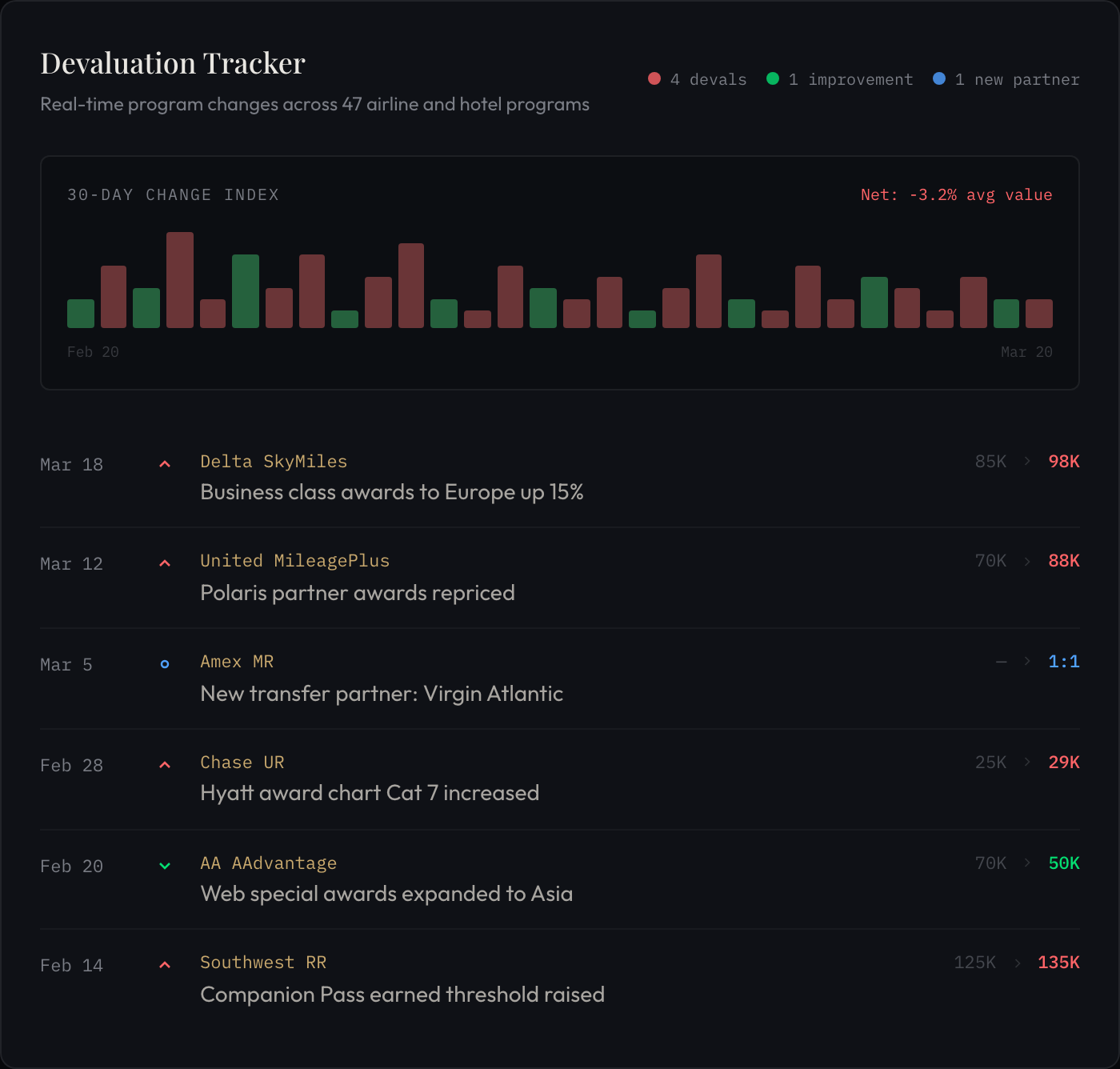
The MileIntel devaluation tracker flags Marriott Bonvoy as one of the highest-risk receiving programs in the current environment, which the scoring above reflects.
The Pattern: What This Table Actually Reveals
The high-ratio bonus is a marketing number, not a value number. The Chase-to-Marriott 55% bonus is one of the largest ratios on the board. It also produces the lowest score. The arithmetic is straightforward: 1.55 × 0.7¢ = 1.085¢ per Chase point converted. Chase points are worth at least 2.0¢. You are trading 2.0¢ for 1.085¢. That is a 45.75% loss of purchasing power, dressed up as a 55% gain. Public valuations make this math unambiguous.The Amex-to-Marriott 20% bonus is worse in absolute terms: 1.2 × 0.7¢ = 0.84¢ against a 2.2¢ source value, a 62% destruction of the original Amex point value.
The highest-value bonuses share a structural feature: the receiving program has meaningful award sweet spots that are genuinely hard to replicate without the transfer. The Amex-to-Flying Blue bonus reduces a 60,000-mile Air France business class JFK-CDG award to approximately 48,000 Amex Membership Rewards points. That same seat costs roughly $4,103 in cash, or 273,500 Chase portal points if you refuse to transfer. The bonus doesn't just improve the deal; it unlocks a redemption tier that is otherwise inaccessible at any reasonable point cost.Similarly, the Citi-to-Qatar 30% bonus reduces a 70,000-Avios Qsuites US-Doha award to 54,000 Citi ThankYou points. That gap — 16,000 points — is significant. It's also invisible to most Citi cardholders because the bonus is offered by Qatar Airways, not Citi, and will not appear on Citi's transfer partner page. You have to check Qatar's own promotions page to find it. That information asymmetry is exactly the kind of edge the MileIntel transfer tools are designed to surface.
The double-discount stack: Flying Blue's June 2026 Promo Rewards offer North America-Europe economy from 18,750 miles (a 25% discount on the 25,000-mile floor). Stack that with the active 25% Amex transfer bonus and a traveler booking a Promo Reward route during the bonus window pays approximately 15,000 Amex Membership Rewards points for a transatlantic economy award. These two promotions are almost always covered in separate articles. They compound.Where This Analysis Breaks Down
Four honest limitations:
1. Flying Blue's dynamic pricing erodes the cpp math quickly. The same award can cost 30-50% more within a single week if demand rises. The 48,000-point JFK-CDG business class figure is real, but it's a snapshot. Flying Blue devalued its award chart in January 2025, raising economy floors from 20,000 to 25,000 miles and business class from 50,000 to 60,000 miles one-way. The June 2026 Promo Reward economy pricing (18,750 miles) reflects a promotional discount below the new floor, not the standard rate.2. Rove Miles cannot be scored with confidence. The program launched in 2025 with 18 transfer partners. There is no established track record of redemption values, no published award chart to stress-test, and no devaluation history. The 50% Turkish Miles&Smiles bonus and the ~44,000-Rove-miles North America-Turkey business class data point are credible, but treating this as equivalent to a mature program would be premature. Treat the 6.5 score as a placeholder.3. Carrier-imposed surcharges are not captured in the cpp math. The Chase-to-Virgin AtGet articles like this in your inbox
The Mileage Run — one short email when something actually changes your travel math. No filler, no affiliate trash, no spam. Unsubscribe anytime.
Frequently Asked Questions
Is the 55% Chase-to-Marriott transfer bonus a good deal?+
No. While 55% is a high headline percentage, the bonus destroys value because Marriott Bonvoy points are valued at only 0.7–0.8¢ compared to Chase Ultimate Rewards at 2.05¢. The post-conversion value loss exceeds 20%, making it one of the worst deals in the June 2026 transfer bonus landscape.
How should I evaluate transfer bonuses beyond the headline percentage?+
Evaluate bonuses on four dimensions: net cents-per-point after conversion (50% weight), whether a specific bookable award exists using the bonus (25%), devaluation risk of the receiving program in the last 18 months (15%), and information advantage or visibility (10%). A bonus preserves value if post-conversion cpp stays within 10% of the source program's value.
What are the best transfer bonuses available in June 2026?+
The article ranks nine bonuses by real value delivered. The Citi-to-Qatar 30% bonus (expiring June 30) and Amex's Flying Blue bonus combined with Flying Blue's monthly Promo Rewards deliver superior value despite lower headline percentages. Rove Miles' 50% Turkish Airlines offer also scores highly due to no credit card requirement and information advantage.
What does 'value destruction' mean in transfer bonuses?+
Value destruction occurs when the receiving program's point value is significantly lower than the source program's value, even after applying the bonus ratio. For example, if you transfer 2.05¢ Chase points with a 55% bonus to 0.7¢ Marriott points, you lose more than 20% of your value in the conversion.
Sources
- June Credit Card and Loyalty Program Transfer Bonuses — Upgraded Points
- Credit card transfer bonuses (June): 55% bonus to Marriott Bonvoy and more — The Points Guy
- Current Point Transfer Bonuses for June 2026 — Roame
- Current Transfer Bonuses for June 2026 — point.me
- Flying Blue Devaluation, Sort Of: Higher Pricing, But More Award Seats — One Mile at a Time
- 2026 Hilton Devaluation: Mid-Tier Hotels Increase in Price — Travel on Point(s)
- Flying Blue Promo Rewards: Award Discounts for June 2026 — AwardWallet
- Flying Blue Transfer Partners: 6 Programs Compared (2026) — SkyStatus
- Get Up to 55% More Points With the Current List of Transfer Bonuses — Thrifty Traveler
Don't Miss a Departure
Track your miles, catch devaluations before the blogs do, and find the best use of every point you have.
Create Your Free AccountSign up with Google · No credit card required